The game so far
Smash Cut is the monster movie you shoot yourself: you play a giant monster wrecking a city for the cameras, then sit in the director's chair to cut the take, and three critics and the box office judge your film. Day 1 got the whole loop playing, Day 2 made the city worth wrecking. Day 3 was a day of three pushes at once: make the world look real, make each monster move like itself, and make the game explain itself to a first-time player, because a judge opens it cold. Mifsopo's notes today were short and sharp: "fix the hill cliff and the outside of map is still bland", "the ground is poor", "the harbor bridge and weird walkway thing too", "when the dam breaks it almost just moves like a flat plane ... like a small mini tsunami that can come destroy the city", "go through all our lowest 20 materials or any blurred materials and fully revamp the realism, weathering, grading". And at 12:39, after playing the noon build: "unlock everything didn't work, because i still had to click new game afterwards", "a lot of our studio cameras are inside buildings not showing the monster", "the opening sequence cameras start in a high rise then pan out, missing most of the shot", "it's also still pretty laggy". Those lines, and 50 numbered decisions (58 to 107), drove 83 stages of agent work between midnight and 13:25 ET. Here is the game as it stands this afternoon: six monsters, three districts, a 90-second take that opens with the monster's own entrance, a chair where you cut the footage, and a premiere. Mifsopo judges feel, look and sound; the agents measured what could be measured.
Sources
- design/qa/decisions_1805.md 58-107; design/qa/mifsopo_playtest_1240.md (rows 1-4 quoted); decisions 92, 94, 95, 82, 97 quoted from decisions_1805.md; 83 stages, 13:25 ET: devlog_build.py --day 3 costs.md; lag status: journal/integrator.md 13:17 (criteria-review-2) "the lag fix is last in the code queue"
The best frames of the day
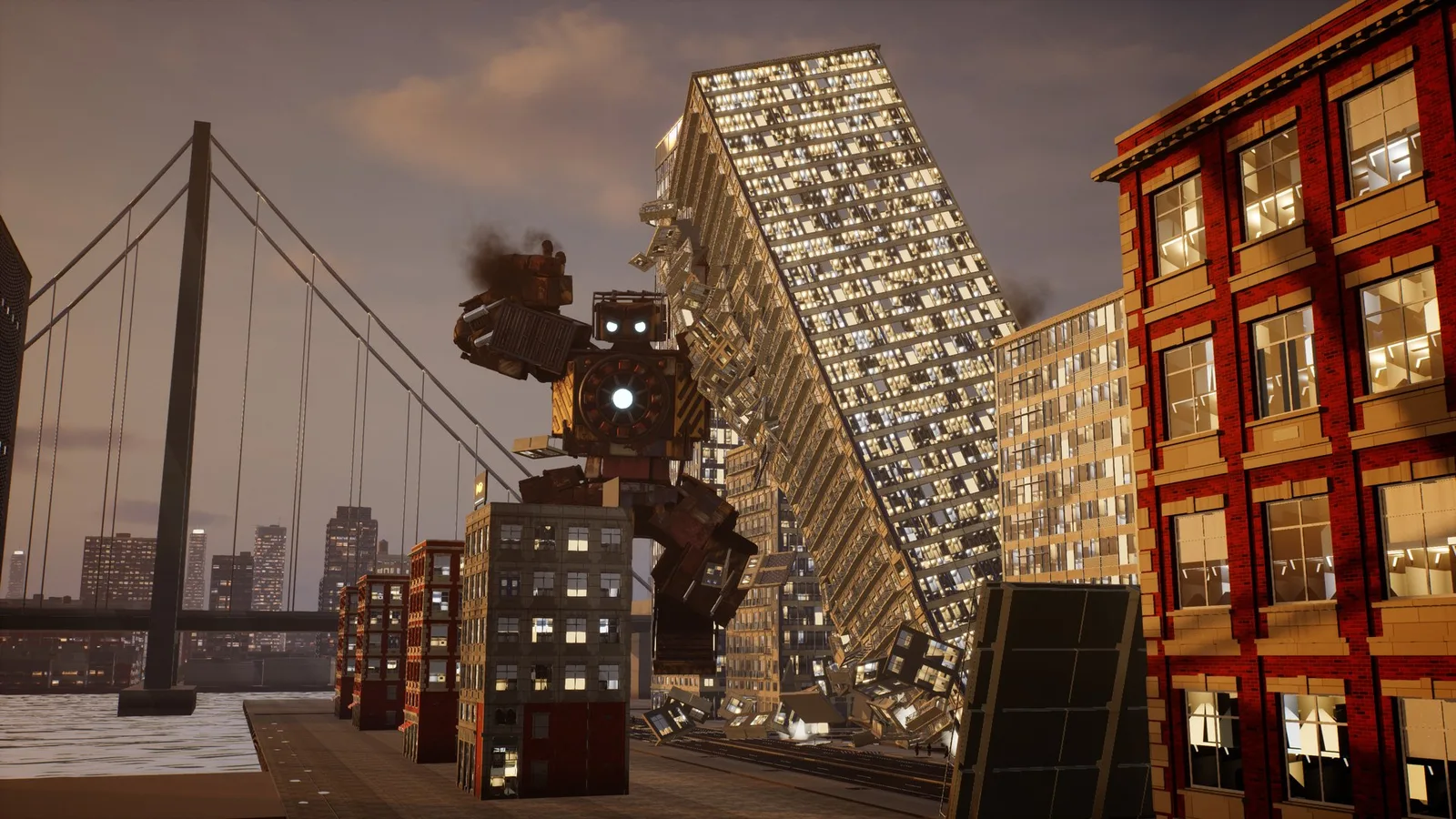
Mifsopo asked at 10:2x for "the best of the best" for #screenshotsaturday. The hero-shot stage made eleven frames of monsters mid-destruction in each district's best light, and the cover is the pick: a whole tower tipping onto Rust Bucket in front of the harbour bridge. Four more are below. They are staged: the agent ran the game on the test copy of the project, set up the monster and the fight, slowed time to 0.4, froze it at the chosen instant and shot several free cameras at the same moment, with the HUD off and exposure fixed per frame. Frame 5 (Pangoliath tearing a tower on Pier Street) is the one where the monster on screen did the damage by its own swing.
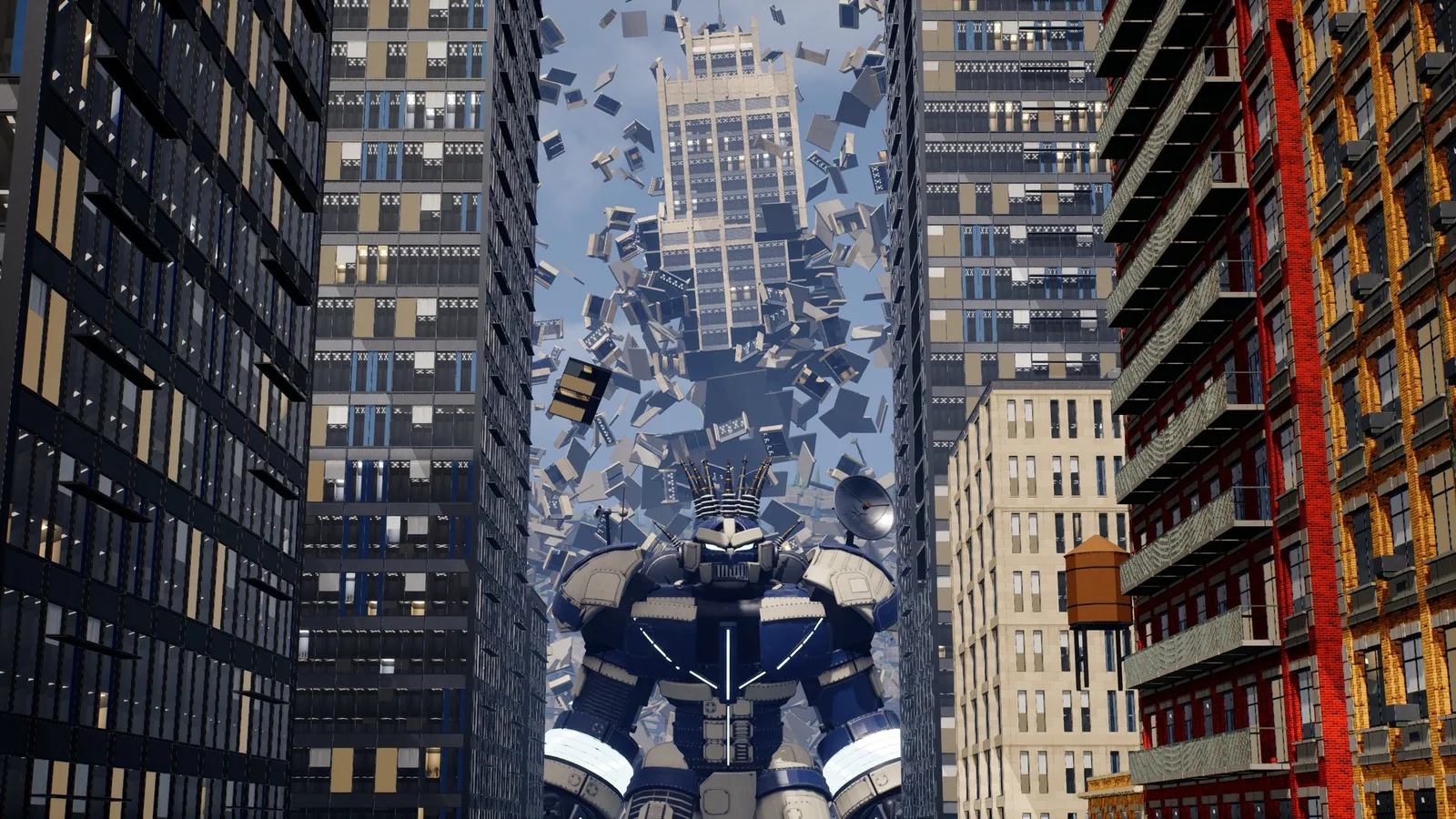
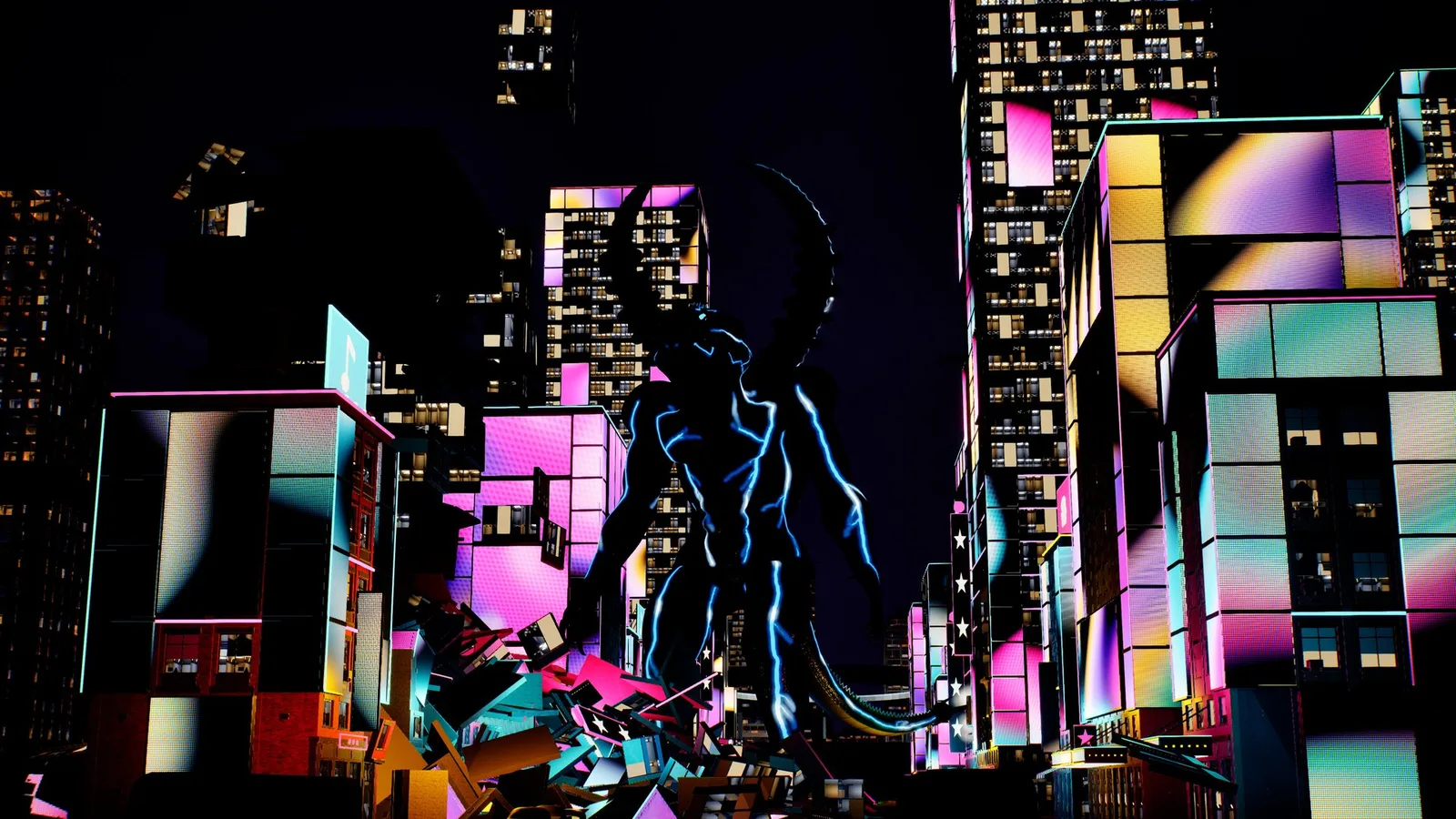
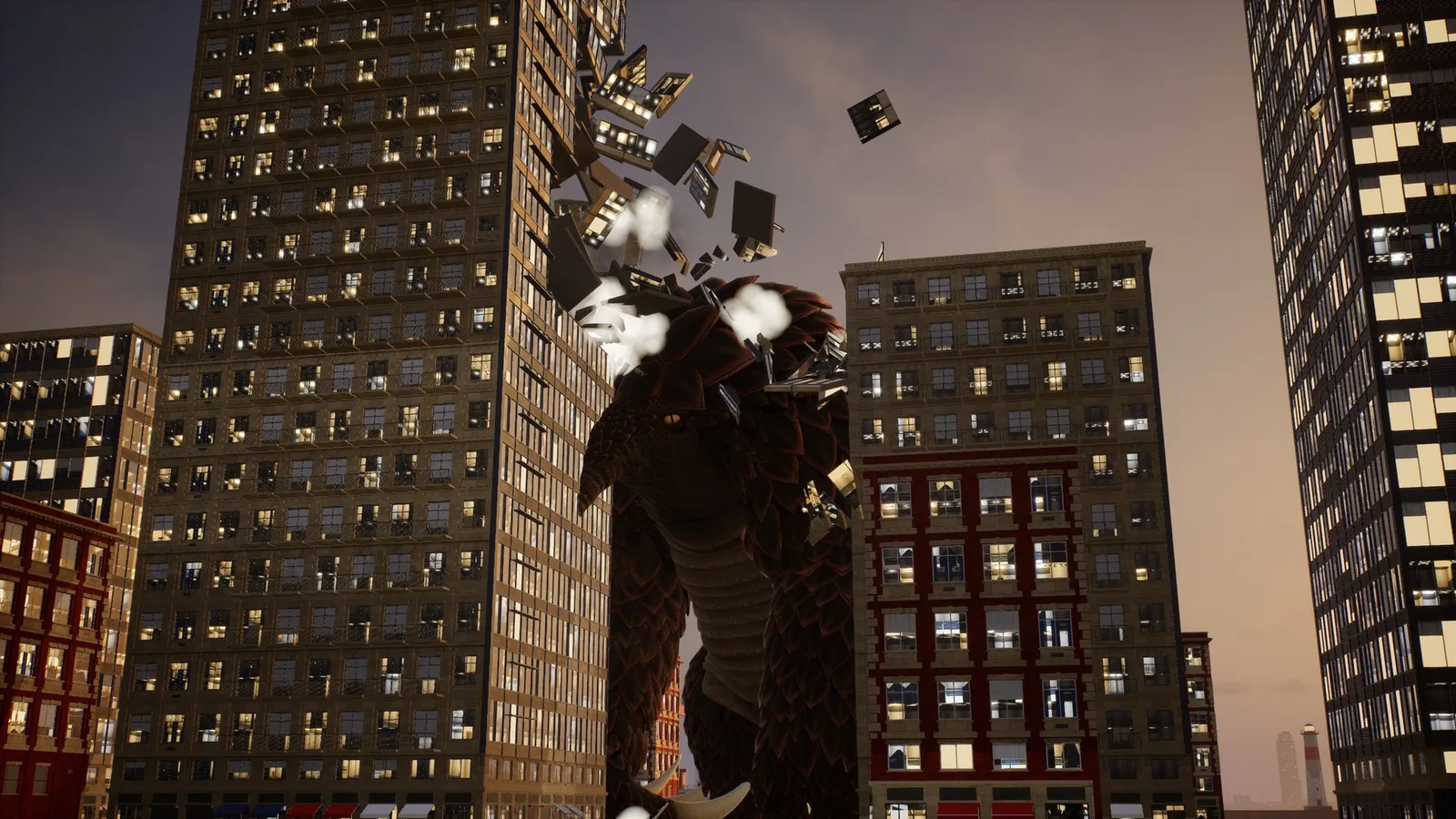
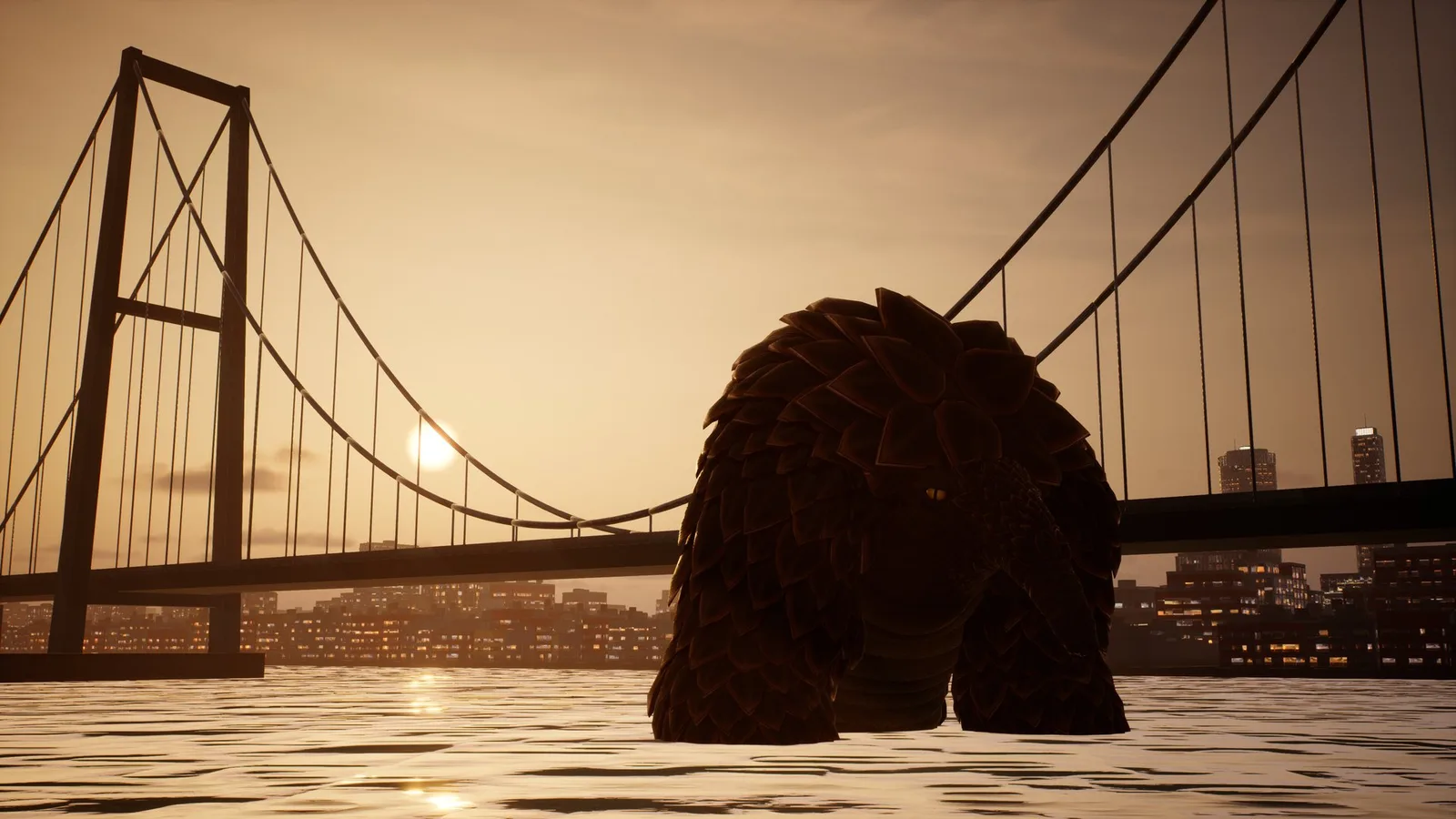
What went wrong on the way, in the agent's own journal: the first Pangoliath placement stood the monster on a 48 m rooftop (the ground trace hit the roof, so it moved to Harbour Boulevard where the trace hit the road); six of the camera positions were inside buildings; the first freeze left a white swipe ribbon across the frame; and "Cast Voltor" mid-session kept Magmahemoth's body until a different command swapped the mesh. Downtown has no golden-hour option in the game (midday or night only), so there is no Downtown sunset frame.
Sources
- journal/devlog_capture.md 10:59 hero-shots (FAIL/FIX lines: trace_ground, capture_camera, live_input_action_value, run_console); devlog/media/social/hero_d3/README.md (ranking, how made, what is staged; Downtown golden hour)
The look: one pass over every district
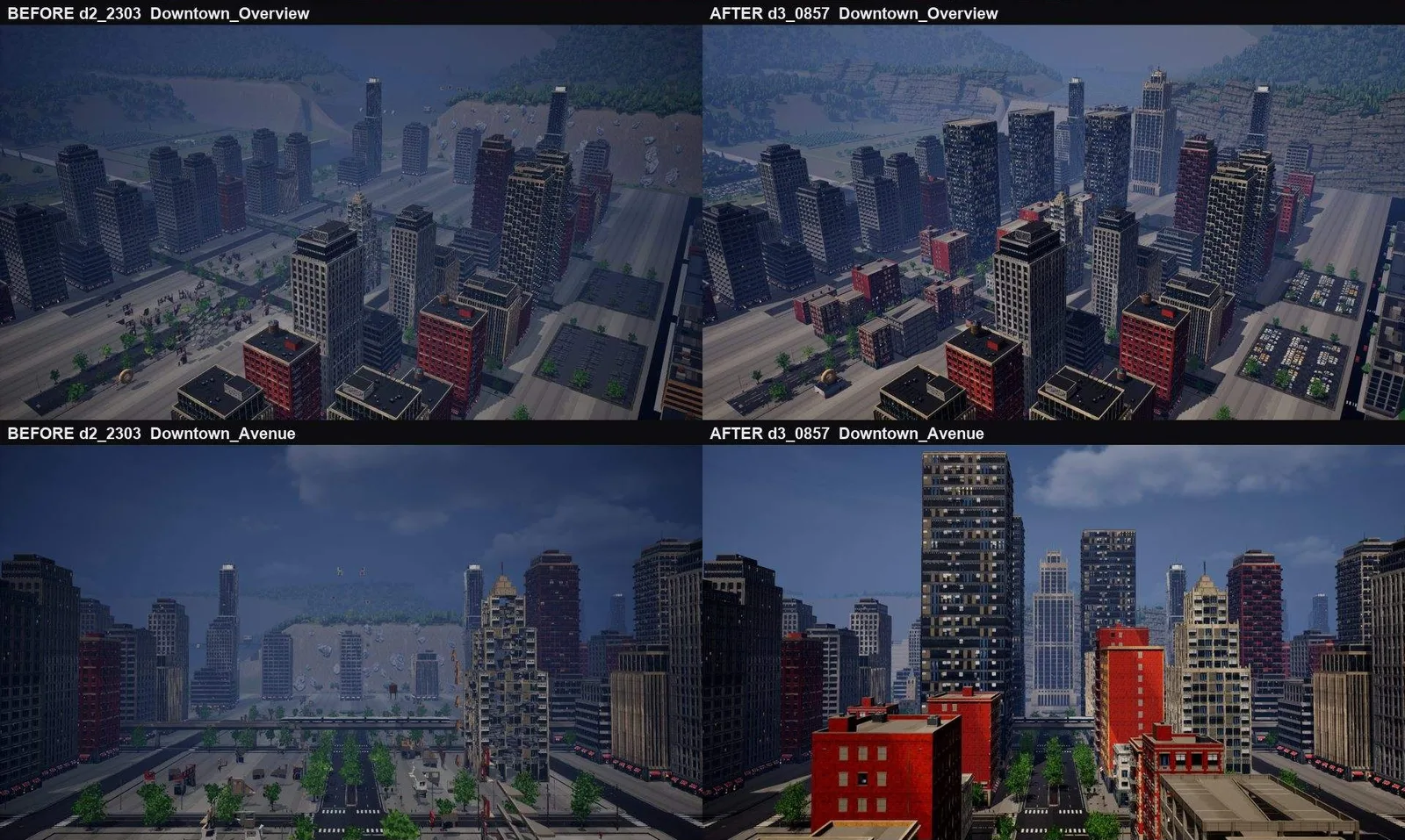
At 00:19 the level lane wrote a look for each map as a table of exact properties (exposure, light, haze, post, reflections, wet street) and at 08:58 applied it. The result in one line from the lane's own journal: Downtown went from blue-grey milk to a crisp warm midday with the haze only on the far city, Waterfront's golden hour is actually gold (colour saturation 0.23 to 0.39), and Neon's sky is a dark blue-violet over wet, sharp streets instead of a bright violet fog, with game-frame GPU time down or up 3.3 % at most on every map. The sheet below is the same cameras before and after, in four parts: left is the capture from before the pass, right is after.
(picture not shown: it did not show its point at page width)
(picture not shown: it did not show its point at page width)
(picture not shown: it did not show its point at page width)
One row to read with care: the Downtown Plaza row's "before" shows tower pieces floating in the sky. That is the early-capture mistake told in the harbour section below, not a change the look pass made.
Sources
- journal/level_lighting.md 00:19 look-files and 08:58 look-apply (saturation 0.23 -> 0.39, 3.3 % GPU); devlog/media/social/d3_0858_look_before_after.jpg cut at its row bands into four parts; media list in journal/level_lighting.md
The edges of the map
Mifsopo's 09:03 note on the first before/after sheet was one line: "fix the hill cliff and the outside of map is still bland." The edge work had started at midnight: past the play area the three cities now continue as mid- and high-rise blocks with lit windows, an avenue with trees and cars, and 480 m super-blocks that fade into the haze, and the North Bluff and the valley wall beside the dam became layered rock with scrub and scree instead of boulders stuck on a tan slope. Left, the 23:03 capture; right, 01:27.
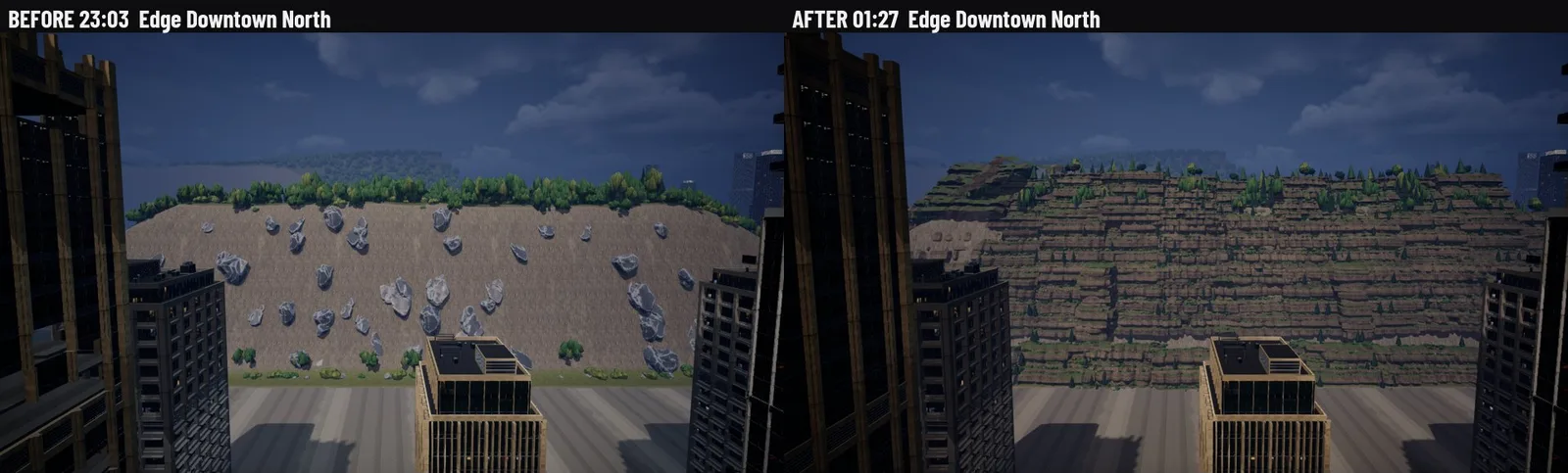
Then came three scored iterations. The first (09:58) turned, re-heighted or swapped 970 far towers that repeated the same shape side by side, put the bluff on a rubble apron, laid the rail line on ballast instead of engine grey, made Waterfront's river one water with a lit building row across it instead of a dark wall, and turned Neon's grey 98 m column into a lit tower, all inside the 10 % frame-cost rule. In parallel the environment lane sculpted the bluff as one escarpment in three seamless sections (edge kit 3), then took it "to a photoreal level" with a 4K sandstone set made in Blender, moss in the crevices, lichen on the sunny faces and dark water streaks under the seeps (edge kit 4). The three iteration sheets, each map's edge cameras before and after:
(picture not shown: it did not show its point at page width)
(picture not shown: it did not show its point at page width)
(picture not shown: it did not show its point at page width)
(picture not shown: it did not show its point at page width)
Each of those passes failed first and said so in the journal: the first bluff read as candy-striped bands on a flat wall; a Voronoi fracture read as crazy paving, so it was replaced by rectangular joint blocks per bed; the rock texture read as dried mud, then as flat, until the noise was remapped before quantising; scrub looked like round green balls; and eight cliff modules on the highway cut stood out of the wall as floating shelves. Each has its fix and its before and after in the Glass Box book.
Sources
- journal/level_lighting.md 01:31 edge-apply-2 and 09:58 edge-iter-1 (970 towers, 10 % rule); journal/environment_props.md 10:23 edge-kit-3 and 12:47 edge-kit-4 (FAIL/FIX lines quoted: candy stripes, crazy paving, dried mud, round balls); decision 92 quoted from decisions_1805.md; devlog/media/social/d3_0135_edges_before_after.jpg, d3_0953_edge_iter1_{dt,wf,ne}.jpg
The harbour was sand, and a capture lied
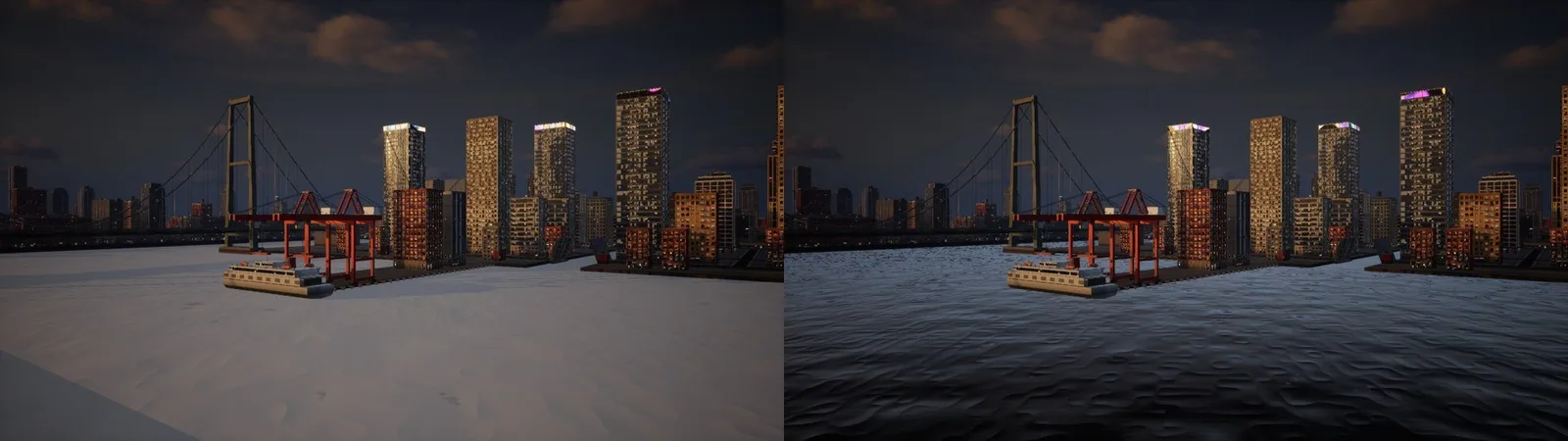
Waterfront's harbour, river and canal had been drawing as pale rippled sand. The integrator's 08:28 stage traced it to the water material's wall-foam, which covered the whole surface there; switching that foam off on the three water materials (harbour wave scale 900 cm) gave dark water with small waves and a sun-glitter path, and the far plane is the same water, so the bright rectangle at the horizon is gone. The same stage chased a second report, tower pieces "hanging in the sky" over the Downtown plaza, and found it was not a bug in the level: the editor capture had been taken two seconds after loading the map, before the towers finished drawing. The same camera 70 seconds after the load shows every tower whole, so the capture routine now waits 60 seconds after a map load. The same early-capture mistake shows in two of our own overnight captures (23:03 and 00:26); the Day 3 GIFs below leave the 00:26 ones out.
Sources
- journal/integrator.md 08:28 water-floaters (FAIL/FIX: capture_camera 2 s vs 70 s after load; set_property bAffectDistanceFieldLighting and ObstacleFoamCm tried and failed; set_material_parameter ObstacleFoamOn 0 fixed); devlog/media/social/d3_harbour_water_before_after.jpg
Materials and facades
Decision 96 (10:36) said to go through every material; decision 97 (11:44) raised it: "we have plenty of time and usage: go through all our lowest 20 materials or any blurred materials and fully revamp the realism, weathering, grading". The vfx lane's audit (11:39, read-only on the test copy) listed every material the three maps draw with how many actors carry it and how much of the screen it covers, ranked by cover times how wrong it looks. It found: the concrete, painted-metal and stone walls are flat because their texture sets hold almost no variation; the glass returned about 5 % of the sky; the brick was tinted twice into poster red; steel was a 13 % dark metal; Neon's screens ran 6 to 10 times over white; and the cars, lamps and six road lanes were a base colour and nothing else. The fixes (12:26) went in rank order: brick is fired clay, glass towers mirror the sky, steel reads as steel, Neon's screens no longer blow out to pastel, and roads, pavements and plazas have a real ground material (asphalt with wheel paths, patches and tar seams; 1.5 m concrete flags with dirty joints; granite pavers with a border course), with no rise in GPU time. A second texture revamp stage was still running when this was written.
Then the buildings themselves. The environment lane built a facade kit (six different 6 m shopfronts, 15 pieces of roof plant, five fire-escape modules, each with a baked wear-and-grime set), and the level lane applied it at 13:18: 2,456 shopfront modules on the towers' own shop bays, stacked fire escapes on the brick towers, 3,692 pieces of roof plant on the roofs, and rain drips, roof run-off, a splash band and a per-building tint on every concrete, stone, brick and painted wall in the game. Left is the 13:08 capture, right is 13:17; the breakable buildings were left alone.
(picture not shown: it did not show its point at page width)
Sources
- design/qa decisions 96-97 (decisions_1805.md); journal/vfx.md 11:39 material-audit and 12:26 material-fix summaries; journal/vfx.md 10:42 ground-files; journal/environment_props.md 01:34 facade-kit; journal/level_lighting.md 13:18 facade apply (2,456 / 3,692, breakables untouched); devlog/media/social/d3_1317_facade_before_after.jpg. The kit's own renders are in the Glass Box book.
Downtown, one camera, all day
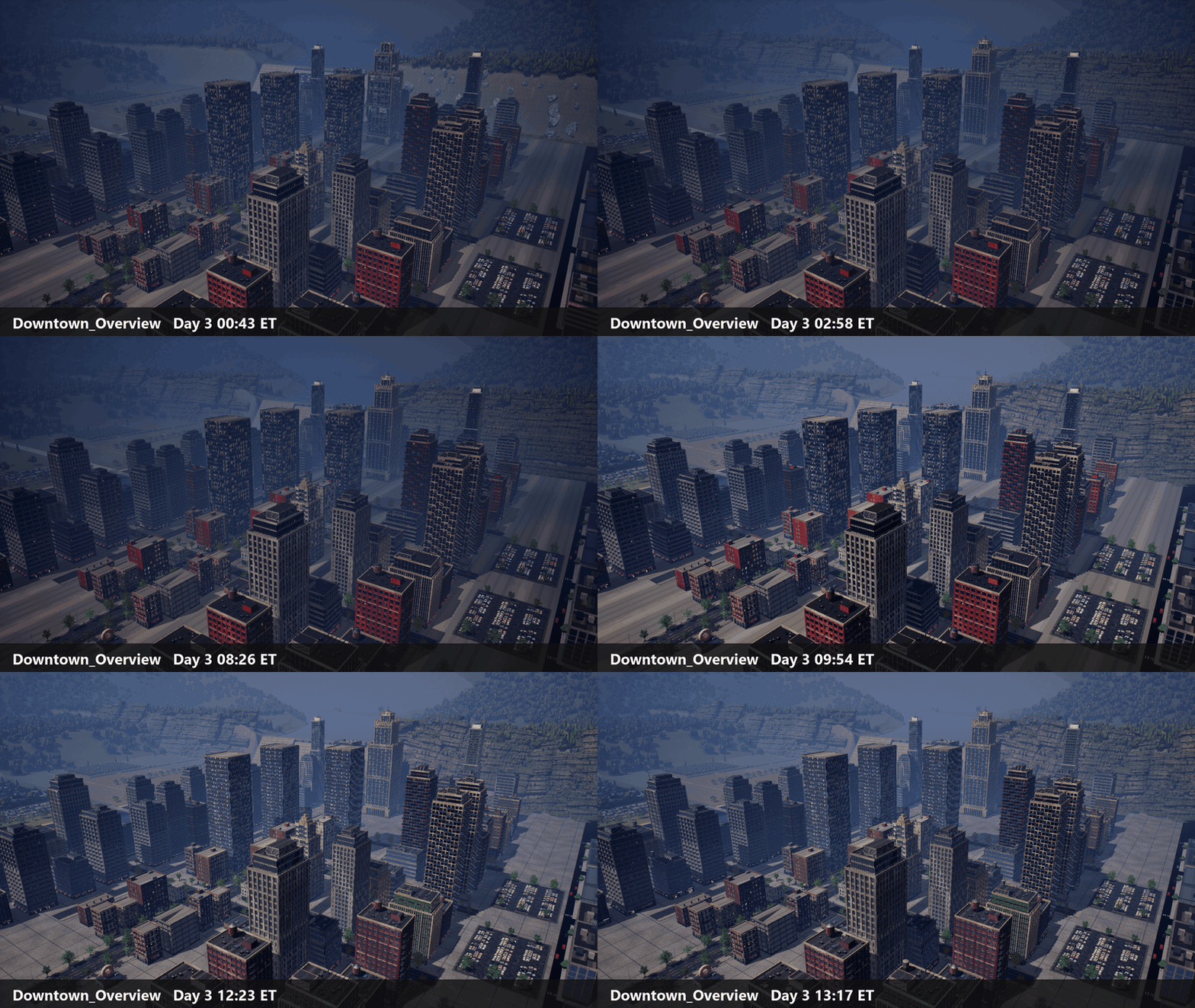
The same four progress cameras as Day 2, one capture per stage that touched them, now for Nov 14. Downtown's overview: 29 frames, 00:43 to 13:17 ET. The towers hold still while the light and the far edge change: the milk-blue haze lifts at the 08:41 frame as the look pass lands (its journal entry is timed 08:58), the bluff gains its rock, and the facade pass dresses the ground floors in the last frame (13:17). (The 00:26 frame is dropped: it is the capture taken before the towers had drawn.)
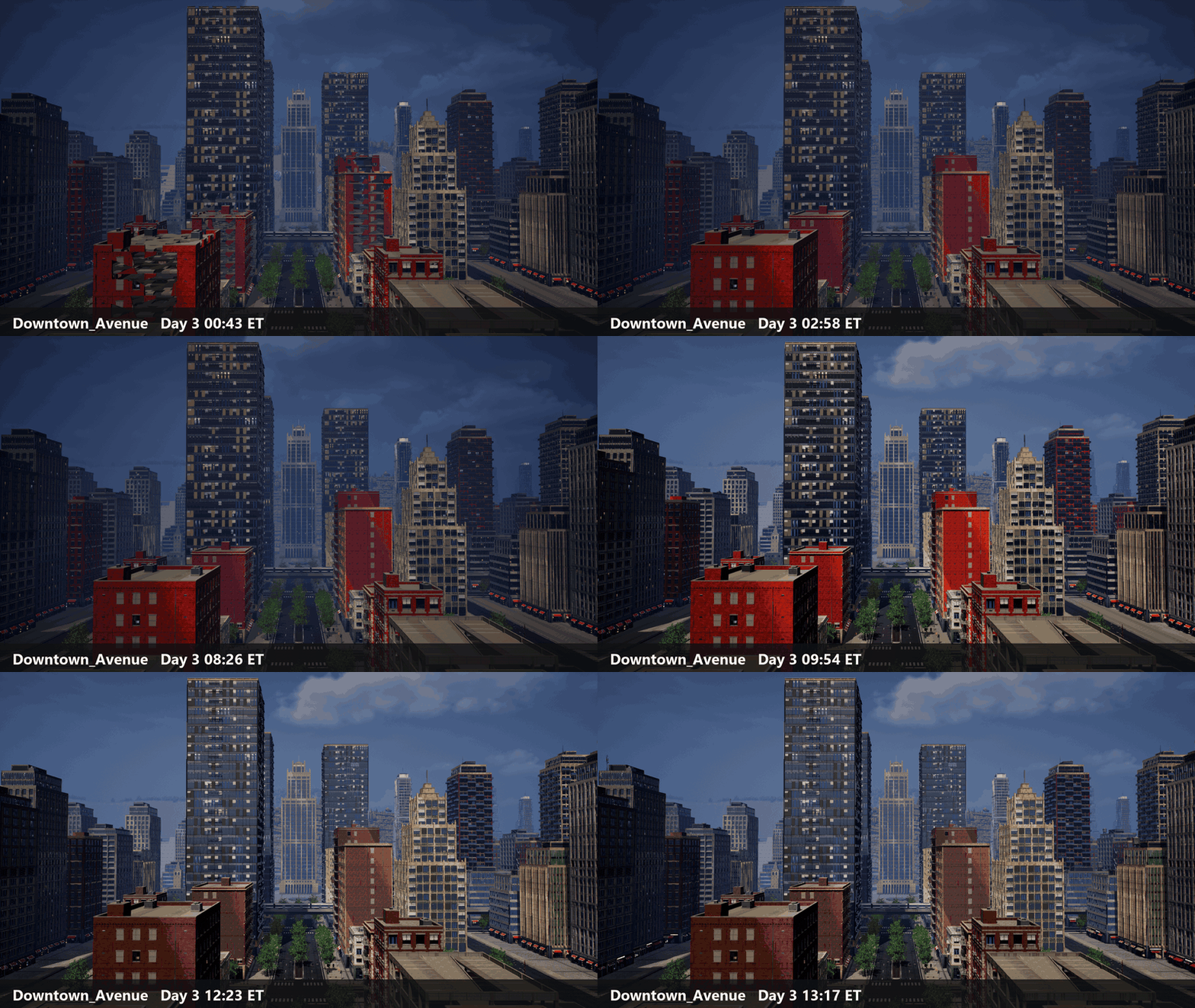
The street-level camera down Downtown Avenue, same 29 frames: the sky changes from flat blue to clouds at 08:41, and the red-brick block in the foreground turns to weathered brown at 12:23 when the material fix makes brick fired clay.
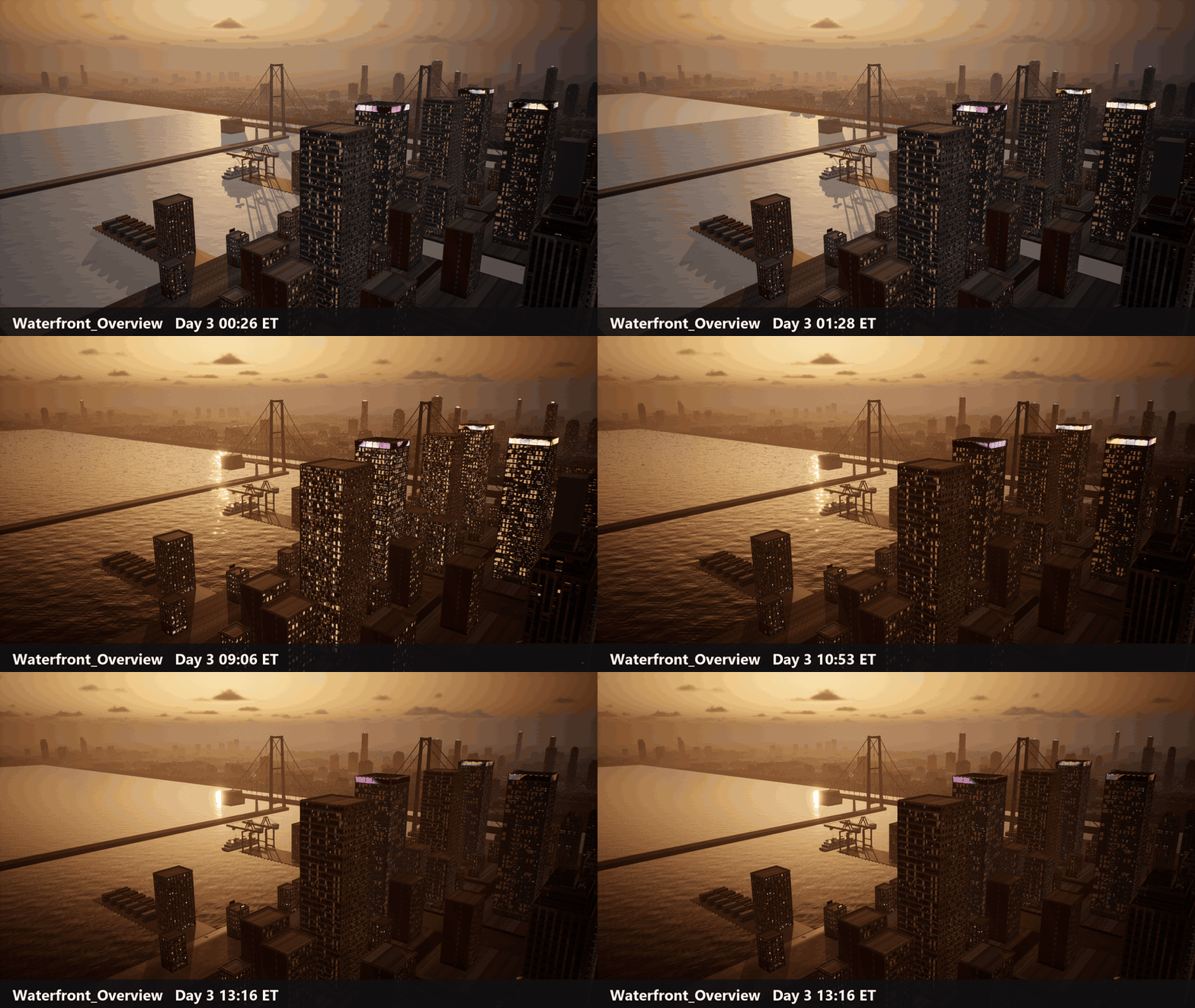
Waterfront's overview, 15 frames (the 02:12 frame, taken before the towers drew, is dropped): the pale harbour of the early frames turns dark and gold at 08:56 after the water fix and the look pass, then the lighting settles into the gold of the last frames.
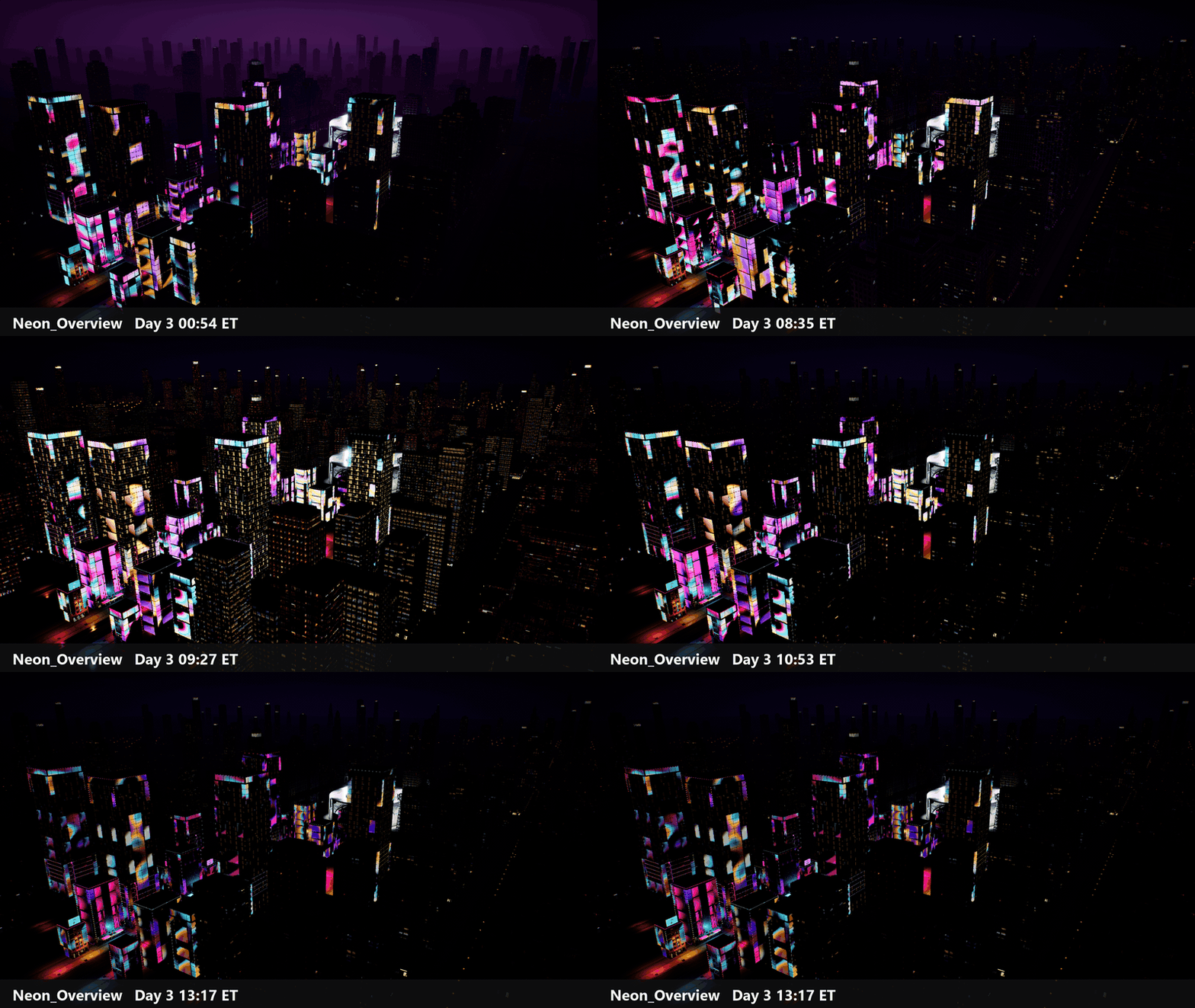
Neon's overview, 14 frames (four captures where the far city had not loaded are dropped): the violet fog of the first frames gives way at 08:35 to a dark blue-violet sky, the lit far city appears at 09:07, and the LED screens change colour and pattern in the last two frames.
Every frame was taken by the agents' capture routine at the end of a stage (never a desktop screenshot). The frame lists were checked by eye on contact sheets before the GIFs were made; the dropped frames are listed in CHECKLIST.md.
Sources
- devlog/tools/d3_cam_gifs.py (drop lists: Downtown 0026; Waterfront 0212; Neon 0026, 0437, 0825, 1157; frame counts printed by the script: 29, 29, 15, 14); contact sheets screened by eye 13:3x; times of the changes read off the frames' stamps and the matching journal entries (look-apply 08:58, water-floaters 08:28, material-fix 12:26, facade-apply 13:18)
Monsters that move like themselves
Mifsopo's decision 86 (05:25) took two packages from a review of the animation. The review's finding, written by the planning agent (claude-fable-5-2, 02:19): all six monsters played the same 31 clips, one idle, one walk, one roar, beat for beat, and the hero stood upright although its design is a hunched knuckle-walker. What changed:
- Pangoliath stands, walks and runs hunched with its long arms swinging so the claws skim the street, roars by rearing up and slamming both fists into the street, and its leap curls into an armoured ball that rolls through the air and bursts into a two-fist landing (decision 87).
- Rust Bucket walks and runs on a piston march with its fists slammed down in two locks for the roar.
- Voltor, Magmahemoth, Sonic-Surge and Frost Titan each have a roar of their own: Voltor shrieks with its 45 m tail arched over its back, Magmahemoth erupts with its head thrown at the sky, Sonic-Surge drives both fists straight up to call the storm, Frost Titan drops onto one fist and roars along the ground.
- Sonic-Surge leaps like a flying hero: a crouch while the thrusters light, a punch, a superman pose with a full barrel roll, and a three-point landing that plants a fist in the street (decision 88: it glides instead of running). An 08:43 pass removed a hang where it paused upright in the air before landing.
- Every monster throws like a pitcher at monster weight, one throw per hold size (a car in one hand, a tank at the belly, a wreck overhead): a squat with the load, a pivot onto the back foot with the knee raised, a stride, the hips opening before the chest, the release at full stretch.
- Holding changed too: what the monster grabs is held by its size at a grip socket on the hand, with its own idle and walk pose, instead of floating in front of it.
The throws went wrong in a way worth telling. The first check found the held object crossing the monster's own body on 72 of 123 checked frames for Pangoliath, Voltor and Magmahemoth (the car through its forearm, the tank into the chest, the wreck into Voltor's head, up to 14,644 of its vertices inside the box). After the object was carried in the chest frame with the wrist bend kept, 234 of 246 frames were clear on all six, the rest 3 to 113 faces at the release frames. And decision 93 (10:16) made the rule explicit for everything new: "all new animations are made fully game-ready: no part passes through another anywhere".
Sources
- journal/characters_animation.md 02:19 anim-flair-plan, 06:28 anim-pack-b, 08:17 anim-pack-a, 02:31 sonic-launch, 08:43 sonic-land-fix, 00:32 throw-anim (FAIL/FIX: 72 of 123; 234 of 246); journal/gameplay_code.md 08:17 hold-code; decisions 86-88, 93
The openings: six ways into the city
Decision 64 and Mifsopo's 21:21 note the night before ("pangoliath magmahemoth come from underground, rust bucket and sonic surge are like transformers, and voltor and frost titan should fall from the sky and impact the ground") became six openings, each on its own hero clip of 5.5 to 6.9 seconds, ending in a roar at the camera and handing over to the idle: Pangoliath and Magmahemoth punch their claws up through a street that cracks and haul themselves out; Rust Bucket and Sonic-Surge assemble like transformers; Voltor and Frost Titan fall from the sky into a landing that sinks into the crater. Rust Bucket's was redone at his word (decision 91: "to look THE MOST like a transformer ... a bunch of pieces get on him and build him"): the opening now runs on a copy of his mesh cut into an endoskeleton and 64 rigid pieces, each on its own bone, that lie on the street or drop from the sky, fly in on arcs, spin, slam on and lock in sequence, with the cab head last and its eyes lighting. Sonic-Surge's chest opens as a hatch for the head to rise through instead of the head passing through the plates (decision 93), measured with no part through another on any frame. Then his 12:45 note: Rust Bucket's roar at the end of the opening is "kinda bad", so the roar animation of every monster is next.
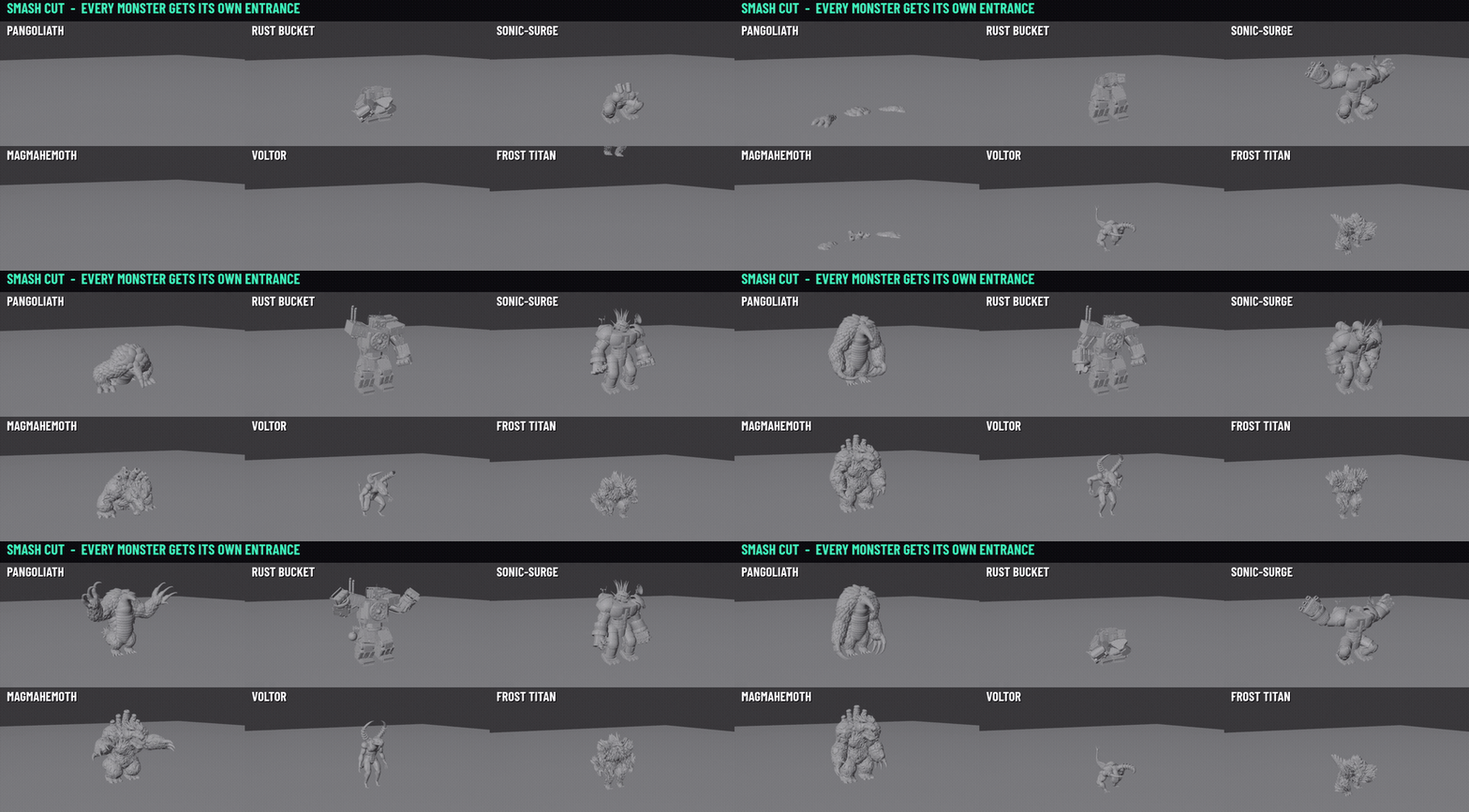
The GIF is a Blender clay preview of the six opening clips side by side, not the game: the openings in the game are not yet shown in a Day 3 capture.
Sources
- journal/characters_animation.md 02:00 opening-anims, 11:24 rustbucket-assembly (64 pieces), 13:08 sonic-hatch; journal/gameplay_code.md 09:11 openings-v2 and 13:14 pt1240-code; decisions 64, 91, 93, 101; design/qa/mifsopo_playtest_2120.md row 4 (his words); mifsopo_playtest_1240.md row 3; the GIF is devlog/media/social/d3_openings_collage.gif (6.2 s, 2.1 MB)
Specials, climbing and a crew in the city
Specials, redone. At 21:21 on Nov 13 Mifsopo wrote that Rust Bucket's and Voltor's specials were hard to see, did not activate the way the monster faced, and "basically all the special moves need revamped". The specials stages made the monster itself spawn each special's effects, from a wind-up tell to the impact, aim it where the camera looks with the body turned there first, and size it to the monster: Rust Bucket's fists fly as rockets and blast where they stop; Voltor's bolt strikes the building in view and forks down the street; Magmahemoth's flame reaches 180 m; Sonic-Surge's clap sends a wave and three bolts; Frost Titan's line runs 200 m and shatters what it froze; Pangoliath's ground slam throws a second ring. The integrator's check on video (11:35) ran every special, hold and opening of the six monsters; it found the specials working, and sent the openings back (the camera started inside a structure at the spawn, two monsters broke the street late).
Climbing. Mifsopo asked the night before "can any of our creatures climb buildings?" The answer was that it had been designed and never built, so it was built: with the stick held toward a tower's facade, Leap attaches the monster, which climbs up, down and sideways, punches bays out of the facade for money, vaults onto the roof at the top, jumps off with Leap, and if the tower falls with it on it, rides the falling part down and lands with a bigger stomp. The integrator's 04:41 check on video: all six monsters attached 70 of 70 tries. It also found what was still wrong: on one tower the first punch always started a ride and dropped the monster (18 of 18 runs), the sideways move stopped at the edge of the facade at once, and at the top there was "no room on the roof" in the test spot. Those went back to gameplay_code; and at 13:21 Mifsopo decided (104) that climbing ships switched off unless a fix and a second climb check pass by 20:00.
A film crew. Decision 77: a visible camera crew in the city. There is now a news helicopter that circles and follows the monster, a camera crane truck at street level and tripod crews at street corners, each camera with a red tally lamp and its own breakable piece. The cameras you cut from in the chair record from those lenses, and if you smash, stomp or hit a crew with a thrown car, that camera's footage turns to static with a SIGNAL LOST card in the chair. The honest status line from the noon build: the police cars and the film crews are still stand-in blocks in that package; the models were built after it.
The army. The army, wired in the last stages of Nov 13, was checked and dressed today: a fight on video in Neon, banners that say what is coming ("INCOMING / TANKS ON THE STRIP", "SIRENS / POLICE ROADBLOCK"), a red edge glow and arrow toward the side the hits come from, and a "TANK VS HELI! +$750,000 BONUS" when a hammer-thrown tank downs a gunship. In two scripted Neon takes, 10 of 12 units were taken out by swings, kicks, thrown tanks and a tank swung into a gunship. One found bug is worth telling: the army's tracers had drawn in plain white at the default width because two switches in the Niagara module were never set; they now draw 1 m wide in hot orange.
Sources
- design/qa/mifsopo_playtest_2120.md rows 2-3 (his words); journal/gameplay_code.md 05:18 specials-code and 08:17 hold-code; journal/integrator.md 11:35 specials-check, 04:41 climbing check (70 of 70; 18 of 18; FAILs quoted), 02:14 military-pie (10 of 12), 13:04 build 1213 (stand-ins); journal/gameplay_code.md 03:00 climb-code, 09:48 crew; journal/environment_props.md 04:59 crew-models; journal/ui.md 02:36 army HUD; journal/vfx.md 02:59 army-fx-look (tracer switches); decision 77
The flood wave
Mifsopo's decision 82, in his words: "when the dam breaks it almost just moves like a flat plane, there's no waves or anything, like a small mini tsunami that can come destroy the city". Four lanes answered it. The environment lane built a modular breaking crest (a 20 m tall curl over a hollow barrel with a foam lip, straight, curved and end-cap pieces that chain across the valley) and a muddy flood surface and floating debris; the vfx lane built spray, mist, debris and impact effects; the gameplay lane made the flood a travelling wave: a 23 m crest that slows from 25 to 15 m/s and shrinks to 12 m before it dies 700 m on, knocking small buildings over, tearing the lower floors out of towers, carrying cars on its face, sending people running and shoving the monster, with the streets flooding behind it and draining later. Its first strike is a moment the critics can quote. His 12:39 playtest gave the one PASS of the note: "the dam water did hit buildings and work", on a build that carries the wave's code but not its new effects.
The art went through the usual failures. The crest's lip had dark slashes and a zig-zag at the toe in clay, the face read as tree bark (hairline streaks up to 1,300 cycles across 20 m), a 60-degree shading split then cut the lip into hard creases, the flood surface rendered as rocky ground, and both debris cars came out upside down because the extrusion matrix sent the side profile's height to minus z. Each was measured and fixed (the creases were aliasing: along-crest noise up to 20 cycles per 20 m on a 1 m grid, now 7 or fewer), and the before and after of each is in the book.
Sources
- decision 82 (his words); journal/environment_props.md 08:04 tsunami-art (FAIL/FIX lines); journal/vfx.md 02:27 tsunami-fx, 12:04 tsunami-apply; journal/gameplay_code.md 10:35 tsunami-code (23 m, 25 -> 15 m/s, 700 m); mifsopo_playtest_1240.md row 6
The judges: what a first-time player sees
Much of today was for someone who opens the game once, cold. The planning model (claude-fable-5-2) scored the game against the seven criteria at 00:15 and again at 13:17: 23 of 35 on the evening build, 26 of 35 on the noon build (Ambition 4.5, Theme 4.5, Fun 3, Gameplay 3.5, Visuals 3.5, Level Design 3.5, Audio 3.5). That is an agent's estimate from the evidence on file, not a judge's score, and its own verdict is that the points left are in Fun. What was built for the first-time player, each by a decision of Mifsopo's:
- The premise on screen (59): "A monster movie you play, then edit." under the menu title and on How It Works page 1, and every opening shows STARRING / DIRECTED BY .
- UNLOCK EVERYTHING (58): a Settings button that opens every district and gives the money for the cast, and a one-time debut bonus so the first premiere pays for Rust Bucket. His 12:39 playtest found it did not work from the main menu (he had to press New Game first); the 13:14 stage fixed that in code, and it is compiled, not played.
- AUTO-EDIT capped at 3 stars (60): a cut left exactly as AUTO-EDIT made it can never score above three.
- Critics who quote your footage (70): lines that name a real moment of your cut with its time ("The bank tower coming down at 0:42 is the shot of the year!"), people and traffic that flee the monster (71), and a premiere that plays the cut's biggest collapse once in slow motion at a third of speed with the crowd reacting (72).
- A sound for every way a building fails (73): glass panes, curtain-wall runs, a whole glass face, rebar groaning before a tower goes, a low collapse roar with a sub layer, a far rumble that carries 500 m, dust hiss and rubble settling: 47 files built in REAPER from the declared library audio, and 17 more for the monster in the water (decision 90: a splash for every step, a wading loop, water pouring off as it climbs out).
- Weather and time of day as shop unlocks (74), a STARRING card and the monster's name on the HUD every take (75), three star-unlocked film looks (80: a 1950s black and white, a three-strip colour look, a 1970s grindhouse look; eleven looks in all in the chair) and optional scoring captions in the premiere (81: "+$2M: SHOT LIST - BANK TOWER IN FRAME").
- A saved premiere poster (57, 78): after the box office, SAVE POSTER writes the player's film as a B-movie one-sheet with the title, DIRECTED BY the player, the critics' half stars and the best critic line as a pull quote, so a player can post the film they made.
- A cold open (65-69): see below.
One name changed for a rules reason. The third look was first called after a registered trademark; decision 89 (08:10) renamed it Three-Strip Colour, because rule 15(d) allows no trademarks in the entry.
Sources
- journal/integrator.md 00:15/13:17 criteria-review (score history: 23 on build 1953 -> 26 on build 1213; "agent's estimate" is our wording; the review's own text says the points left are in Fun); decisions 57-60, 65-81, 89, 90; journal/gameplay_code.md 01:13 criteria-code, 03:53, 04:35, 13:14; journal/ui.md 05:43, 13:03; journal/audio_music.md 03:07 (47 files), 08:57 (17 files)
The cold open, and the choices behind it
Mifsopo was shown three storyboarded ways to tell the player they are the director and the monster before the menu: a producer's telegram, a 1950s coming-attractions reel of the six posters, and a night walk through the studio lot. He picked B, COMING ATTRACTIONS, and the closing lines "WANTED: A NEW DIRECTOR. / YOU CALL ACTION. YOU ARE THE ACTION. YOU CALL CUT." (decisions 66-67); it plays on launch until a career exists, can be skipped from the first second and replayed from Credits and How It Works (68), with the orchestral studio ident and our registered hit cues under it (69). It is 34 seconds: after the Unreal Engine logo, our studio's 3D gate in sepia, six posters whose directors get stamped QUIT beside their still-readable names, the film burning out, then a 3D director's chair under a monster's claw shadow. His note on the mock-up (76) was that the studio-lot and city backgrounds were drawn flat, so the environment lane replaced them with 3D Blender plates; at 11:56 he found the hand holding the clapperboard "a bit odd" (99), and the hand, board, words and claw shadow are being redone together.
Sources
- journal/ui.md 00:33 cold-open plan, 02:02 files (DECIDED lines: options shown B Coming Attractions | B + the eye shot | A Telegram | C Lot at Night), 05:18 apply; decisions 65-69, 76, 99; journal/environment_props.md 04:09 intro-art
The trailer
The Day 3 trailer on YouTube: youtu.be/VUGU-RE92vs.
Sources
- the link as Mifsopo gave it, filled in for the site on 2026-11-15 by devlog_capture site-v2 (decision 158)
Mifsopo asked at 11:54 for a full game trailer beside the 30 to 60 second jam video (98), and chose its voice after the advice (100). By 16:53 it existed: 61.7 seconds at 1080p and 60 fps, the narrator's lines laid over the game's own cold open and 22 recordings of the build, each made one frame per 1/60 s of game time on the test copy (six openings, the BANK and bridge collapses, a tank throw, the army, the flood, the Neon blackout, a real take with its HUD, the chair, the premiere, the critics and the box office), cut to his music pick at -14 LUFS, with 4:5 and 9:16 versions for socials. He watched it and answered with notes (116, 120, 121, 123): show all six openings, hold every opening until its beat ends (Rust Bucket's assembly and Sonic-Surge's landing were cut too soon), re-cut the cold open to the voice so each card is up while its words are spoken, and make the subtitles pop word by word. Version 2, built 19:40, is 74.2 seconds: three fast cuts on "Rise / Build / Fall" (Pangoliath out of the street, Rust Bucket building itself from scrap, Frost Titan falling from the sky), then a 3x2 grid of all six openings that hit their big moment on one music hit, kinetic captions in the game's own type, a clean version with no captions and an .srt. His verdict at 19:50: "beautiful". The one thing left: the white swing streak still showed in two beats (about 50 to 53 s and the chair monitor at 57 to 61 s), so those are being re-recorded after the streak was switched off (127, 133); that stage was still running at the cut.
Two failures belong here. The first Frost Titan opening in the trailer held the monster 54 to 71 m over the Neon street, and when gameplay_code checked, every opening on all three maps held its monster 50 cm in the air; the fix stands the feet on the ground before anything is built from them (stage opening-landing). And the first trailer recording of a fresh profile never started: a new player's one-time "how a shoot works" card paused the game, so 9,392 frames recorded 0 seconds of play. A judge who starts the build gets the same, fixed openings.
Sources
- journal/devlog_capture.md 16:53 (Summary, FAIL pie_record t_probe1), 19:42; devlog/media/clips/d3_trailer_README.md; decisions 98, 100, 116, 120, 121, 123, 127, 133; journal/gameplay_code.md 17:19 opening-landing
Roars, a clip audit, a remade Frost Titan and a gallery
At 12:45 Mifsopo said Rust Bucket's new roar was "kinda bad" and asked for every monster's roar to be revamped (101). By 14:54 all six roar to one hero shape: a deep inhale, a release thrown at the camera with the back arched and a foot stamped wide, a 1.2 s hold that shakes, and a heavy breath out, with each monster in its own character (Pangoliath rears and rakes its claws through the street, Rust Bucket ratchets back in clicks, Voltor whips its head, Magmahemoth heaves its lava chest, Sonic-Surge locks into a power stance, Frost Titan heaves with a breath plume). The same roar ends all six openings. Then an audit played every clip made on Nov 14 on every monster that uses it and found parts passing through each other: 15 clips were re-exported so the swinging arm leaves the face on all four flesh monsters and Pangoliath's claws and toe claws leave its thighs and the street. The game's clips keep their names, so no code changed.
For the itch page the render seat made 18 full-material gallery renders (hero, full body and face close-up for each monster) with nothing composited on them. The check of the first set found three faults: Pangoliath's and Voltor's heroes showed chin and neck instead of faces, and Sonic-Surge's plates carried blocky patches. The patches were facet steps baked into the normal map from the faceted high-poly, not a low-resolution texture, so the flattened normal map was imported into the game at 20:07 as well (132). At Mifsopo's word (119, "dont hold anything on it, its not a priority") the Frost Titan was remade at 17:08: 3,200 thin frost-tipped locks instead of grey rock clumps, clear refracting ice, and the stray tusk gone so every tooth stays inside the lips, on the same 35-bone skeleton so nothing else waited on it.
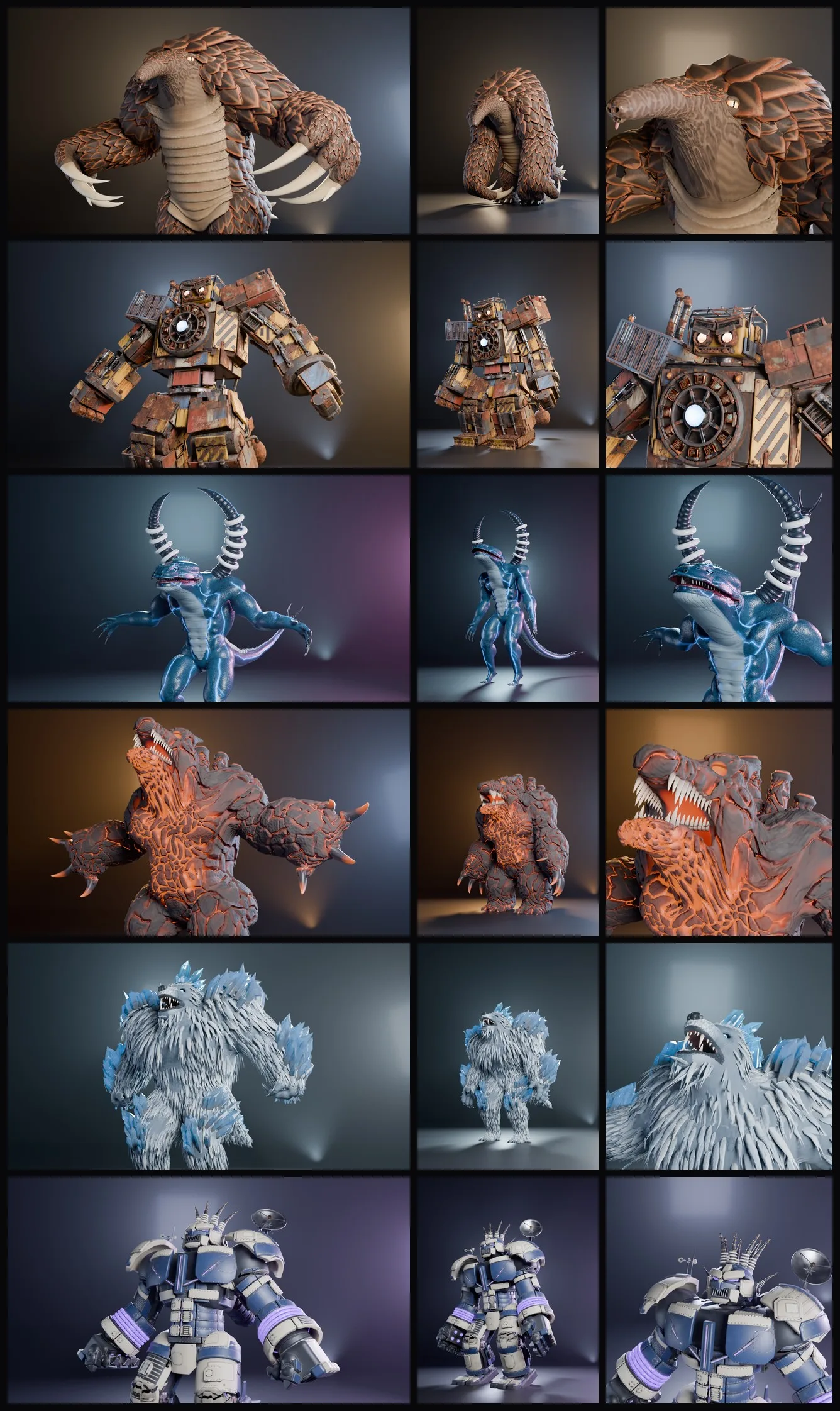
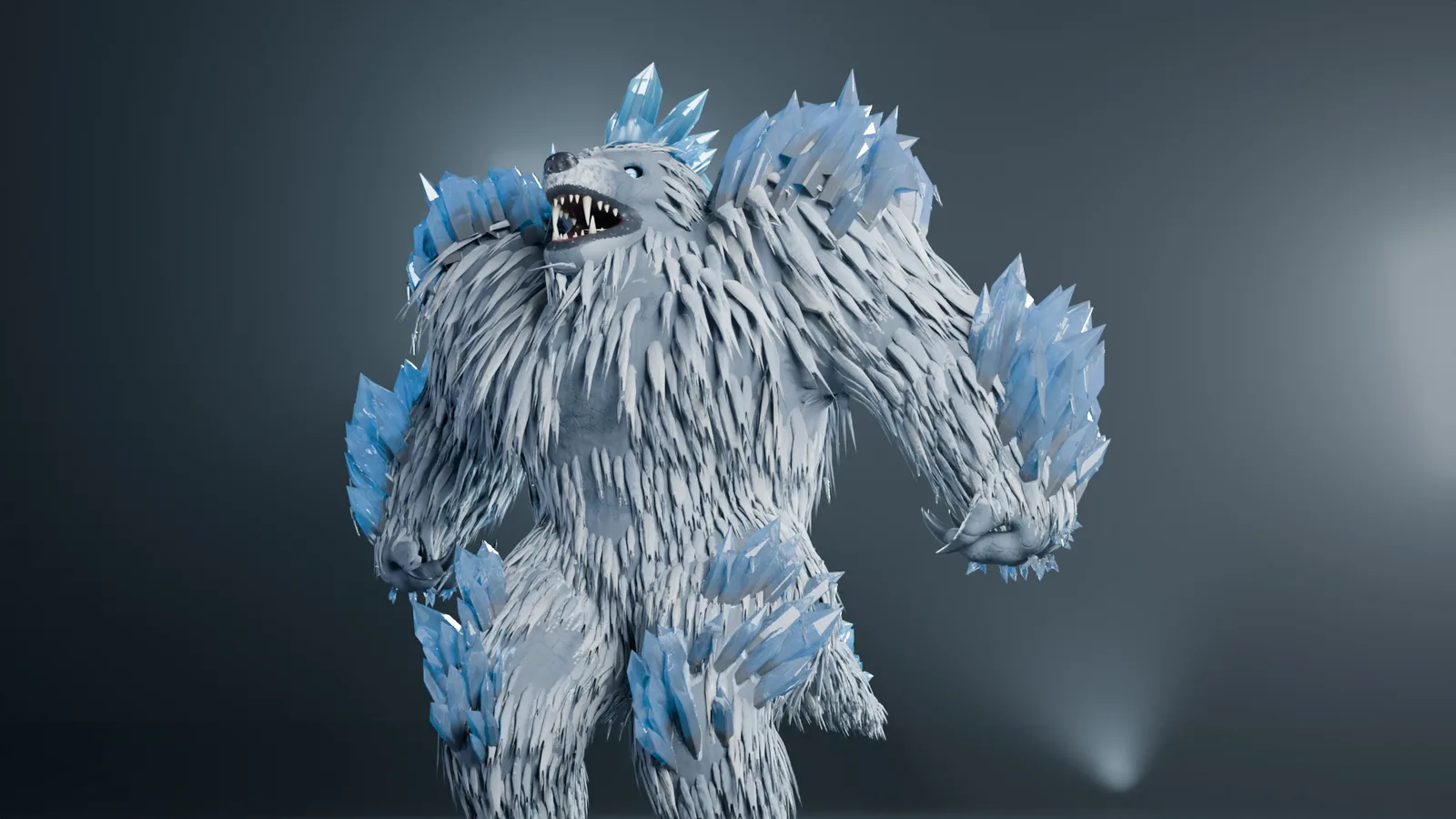
Failures here: the first Frost Titan normal bake pointed 10 % of its texels into the surface and left black slits at the lock roots in the close-up (before: FrostTitan_rootslits_before.png); and re-importing over its mesh doubled the 12 sockets, and removing them took both copies, which the integrator caught by reading the socket list back.
Sources
- journal/characters_animation.md 14:54, 16:21, 16:38, 17:07, 17:08 (FAIL lines); journal/integrator.md 17:19, 18:31, 20:07; devlog/media/gallery/README.md; decisions 101, 118, 119, 132
The last passes on the map, the materials and the cars
Three passes shaped the end of the day. Edges, one final pass (level_lighting, 16:45): past Downtown's north edge one sculpted sandstone escarpment replaces the stacked slabs, the West is hedged farmland with woods, a town and far ridges, Waterfront gets a rubble breakwater with a lighthouse and a bridge with stepped riveted towers and a truss deck, a container port with cranes and ships stands across the channel, Neon's outskirts are lit low-rise streets under three elevated highways, and parked cars and buses stand at their stops. Then edge-fix-final (19:48, decision 132: "fix ANYTHING that remains that you havent touched yet") treated the valley walls beside the dam, put a dirt-and-scrub verge at the bluff foot, cut Waterfront's lit windows to a quarter, and made Neon's near roofs read dark grey with detail; and vfx-fix-final (20:02) ripples the harbour's sunset towers into long broken reflections instead of orange contour bands, makes Neon's LED walls crisp content on a visible cabinet grid instead of pastel gradients, and weathers the stadium bowl.
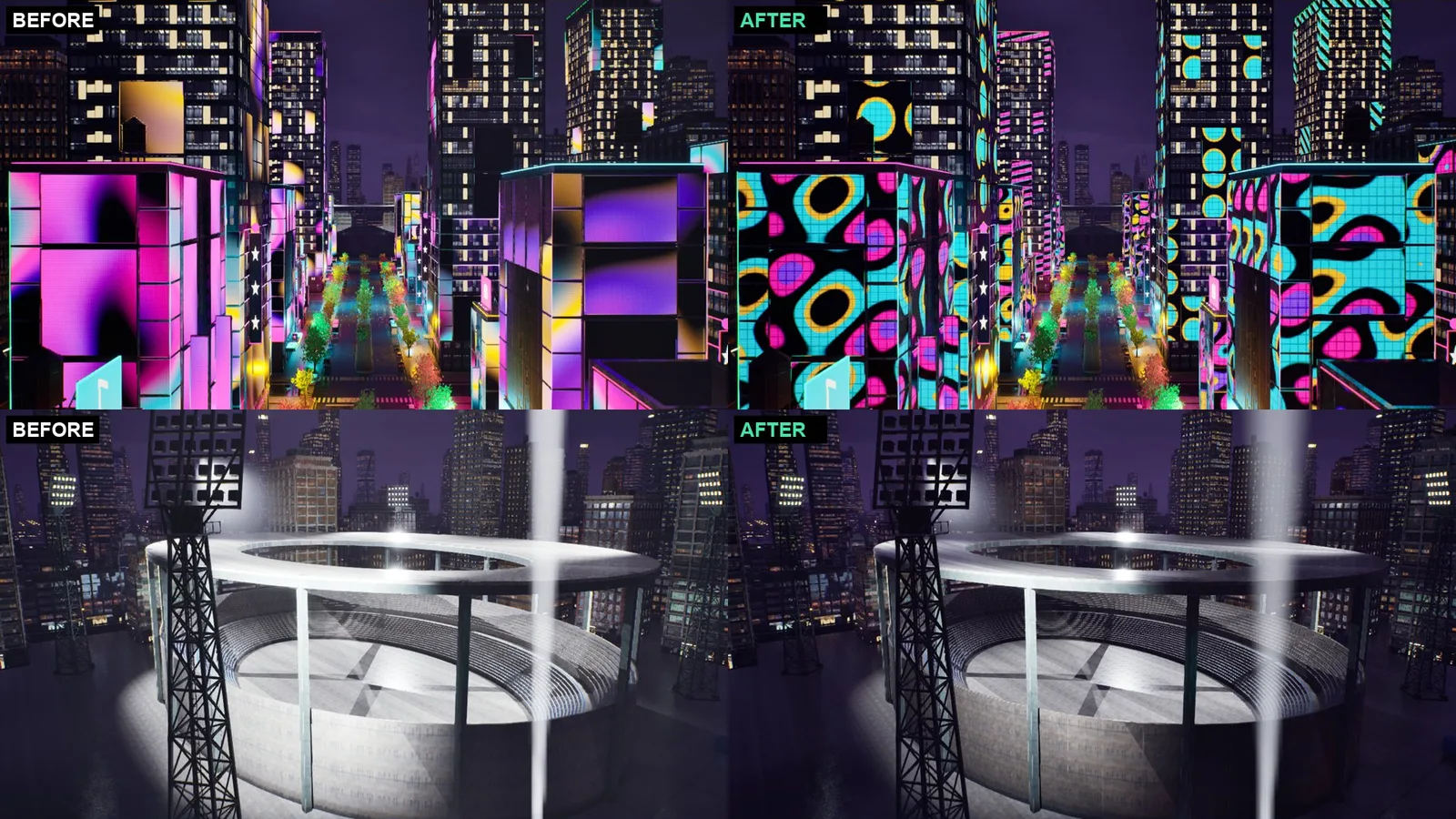
Materials: the second texture revamp (14:12) made brick, rusted steel, timber, turf, awnings, stadium seats, glass grime, car paint, chrome, tyres and cliff scree real 4K texture sets with relief and weathering masks; with the first revamp's, 28 of the 33 sets are on the city, imported at a 2K cap (most at 1K) to stay near the package gate (106; raised to 2.2 GiB at 20:18, decision 134, as the alternative to capping facades at 1K). Cars: every car in the game wears real car materials (clear coat, chrome, tinted glass, tail lamps that glow on the night maps, a different colour for each parked car), and Downtown's 323 lot cars, the last of the crude low-poly set, were swapped for the detailed SM_CV cars (126). The first material pass failed in plain view: the Downtown lot cars read as black shells under a streaky film. A marker test showed the slots were right and the fault was the values, so the near-black paints were lifted and the glass film cleared (17:26). The edge pass also put its first fields over the lot cars (cars on a ploughed field) before a remove list fixed it.
Sources
- journal/level_lighting.md 16:45, 18:40, 19:48; journal/vfx.md 15:01, 17:12, 17:26, 20:02; journal/environment_props.md 14:12; decisions 106, 126, 132, 134; devlog/media/social/d3_2005_final_fixes.jpg
Lag, quality and a game that explains itself
The 14:10 perf-fix rebuilds only the buildings a take touched when a replay starts (his 12:31 session had frozen 2.1 s rebuilding all 85), keeps the monster's camera out of a collapsing tower until its pieces settle, and lets rubble heaps fall asleep in the physics. The 15:03 quality setting gives Low, Medium, High and Epic; a first-start hardware benchmark picks a level (Epic on this machine); lower levels shrink the rubble and effects budgets while the far city and cliffs stay in view; Settings shows it as "Graphics quality" and the main menu says once what it picked (105). Climbing ships switched off: W and Space at a wall is the plain leap (104, 110). The loop, ACTION / CUT / PREMIERE, is on the main menu and on a one-time card before the first take, and a page-header image shows it with the real chair and premiere screens (107). The first test of the quality setting also measured a paused game: the one-time loop card covered the view.
Sources
- journal/gameplay_code.md 14:10, 15:03; journal/ui.md 14:14, 15:30; decisions 103-107, 110
What Mifsopo did today
- Played the noon build and wrote the 12:39 note (four problems and one PASS), then asked whether the agents could record smooth 60 fps footage and capture shots instead of him (as the note records it, recording, playing and code work at once was too much).
- Made 78 decisions (58 to 135). The ones that changed the plan: the trailer, the two-video split, the five after the 13:17 review, the sound of the cold open, all six openings in the trailer, and the evening's cuts of the trailer and the dev log (below).
- Chose the cold open, its closing lines, and the music under it.
- Moved the feature freeze from Saturday 12:00 to 20:00 ET (79), and said at 11:44 "we have plenty of time and usage".
- Decided the entry needs two videos (102): a trailer with a voiceover, the cold open and music for the socials and the itch page, and a separate jam-form video that is all recorded gameplay, 30 to 60 seconds, gameplay from the first frame, no voiceover. He asked for the full trailer at 11:54 (98) and chose its voice at 12:12 after the advice (100).
What Mifsopo decided (decisions 58-135)
Decisions 58 to 85 came between about 00:30 and 02:15, mostly as answers to menus the agents showed him; 86 to 107 came through the day, many in his own words. The full list with the options he was shown is in the Glass Box book. In short: show a judge the whole game (58-62), the entry video plan (63), the order of the openings (64), the cold open (65-69), what the critics and the premiere do (70-72), sounds, weather and the STARRING card (73-75), the film crew and the poster pull quote (77-78), the freeze moved (79), film looks and captions (80-81), the flood wave (82), rolling blackouts, lasting fires and monster grime (83-85), animation packages A and B (86-88), the trademark rename (89), the water reacting to the monster (90), Rust Bucket's assembly (91), the cliff and the bland edges (92), the poor ground (94), the harbour bridge and breakwater (95), going through every material (96-97), the trailer and its voice (98, 100), the clapperboard hand (99), the roar (101), two videos (102), and five after the 13:17 criteria review: perf-fix goes before the effects-heavy work (103), climbing ships switched off unless a fix and a second climb check pass by 20:00 (104), a graphics quality setting (Low, Medium, High, Epic) plus a hardware benchmark on first start (105), the revamped textures imported with a 2K cap and a package-size gate that stops at about 2.1 GiB (106), and, to "yes i want that", the loop shown as three steps (ACTION - wreck the city, CUT - edit your take, PREMIERE - face the critics) on the main menu, on a one-time card before the first take and as a header image for the itch page (107).
Sources
- design/qa/decisions_1805.md 58-135 (options shown are in the file; 78 = 135 - 58 + 1); mifsopo_playtest_1240.md "He also asked"; 79 feature freeze
The test editor and the render offload
Two changes to how the work is done, both Mifsopo's. At about 01:55 ET he allowed a second Unreal editor on a copy of the project: the main editor stays the one writer of the real project, and a test editor on a mirrored copy only plays, records, measures, rebuilds its own code and packages. Nothing from the copy ever goes back to the real project; findings go in the journal, and the next sync overwrites the copy. It is what the hero frames were shot on, what the material audit read from, and where the noon build was packaged (build 1213: 2.027 GiB, 71.5 MB over the size bar, and its exact folder was played through the whole loop five times with no crash: Downtown once, Waterfront twice, Neon twice) without anyone touching the writer editor.
The other is render offload. Every asset gets clay, wireframe and final renders for this dev log, and the Blender renders compete with the game editor for the one GPU. A router now decides each render: local when this machine has 12 GB free and the render lock is free, otherwise a second render seat, same Blender and same settings against a byte copy of the scene, with the textures relinked and a job abandoned (and rendered locally) if anything is missing, so a missing texture abandons the job instead of rendering pink, and nothing waits forever. On Nov 14 up to 13:28 ET it made 547 routing decisions: 288 local, 258 remote, one local without the lock; of the remote jobs, 248 finished and 8 were abandoned back to local. The second seat is not named here.
Sources
- CLAUDE.md section 3 (Changed 2026-11-14 ~01:55 ET by Mifsopo); journal/TEST_EDITOR_OWNER.md; journal/integrator.md 13:04 (build 1213: 2.027 GiB, 71.5 MB over, five play-throughs); scripts/render_offload.py header (routing rules); logs/render_routes.jsonl counted 13:28 ET: route local 288, remote 258, local-unlocked 1, remote-done 248, remote-abandoned 8
What failed, and how it was fixed
One pair per lane, from the day's journals (the Glass Box book has more):
- characters_animation,
evaluate_at_frame: the read-back of the exported Rust Bucket opening was 142.9 m off (head 143 m from frame 102). Cause: Blender's FBX importer took the frame the file was saved on as the rest pose and divided every scale key by it; the keys in the file were right. Fix: save the keyed copy on the clip's last frame (idle pose, every scale 1) and re-export: worst error 0.027 cm on all 13 checked frames.
- environment_props,
bake_texture_set: every vehicle bake before 02:16 came out a patchwork of face-sized blocks because each shell face had its own random seed. Fix: one seed for the whole shell; all 18 vehicles re-baked.
- environment_props,
material_from_maps: three Blenders wrote the same scratch folder at once, so sidewalks and walkways drew magenta in the 10:59 previews (0.87 % of one close-up). Fix: one folder per Blender; magenta 0.0000 on the re-render.
- integrator,
capture_camera: the "floating towers" above, and the harbour that stayed pale sand through three failed attempts (taking the water out of the distance field, two foam distances) until the wall-foam switch.
- ui,
get_property: the STARRING card never showed: it was a child of the take HUD, which sets its own opacity to 0 while the opening plays. Fix: its own widget; the card read 1.0 at 5.2 s.
- vfx,
build_material_graph: 11 plain materials under the army folder were rebuilt although no unit mesh used them: the agent read the folder, not the meshes' slots. Found by describing the meshes; each was put back to its single parameter.
- gameplay_code, build: the specials code failed to compile on two errors (a pointer compared with an incomplete type; a local variable hiding a member); both fixed in the same stage.
-
devlog_capture, loudnorm: the first test cut of the entry video normalised +51 dB of noise: Mifsopo's Nov 13 evening recordings carried no usable game audio (-64 to -70 LUFS). Fix: the cut script now refuses a mix needing more than 25 dB of gain.
-
vfx, capture_viewport / set_material_parameter: the Downtown lot cars read as black shells under a streaky film after the car materials. A marker test showed each car's glass and paint were on the right parts, so the fix was in the values: near-black paints lifted to graphite and slate, glass made darker and clean (17:26).
- gameplay_code,
build_editor.ps1: the first opening-landing compile (17:17) had the landing check before the frame's pose; on a legacy Drop row it would have blended the body 1.6 m under the street. Found by reading the code before it ran, and fixed.
- characters_animation,
render_still: the gallery's Sonic-Surge plates showed blocky patches that looked like a low-resolution texture. It was facet steps baked into the normal map; flattening them in the map fixed the gallery and, at 20:07, the game.
- devlog_capture,
pie_record: a new profile's one-time loop card held the game paused, so the first trailer recording of 9,392 frames had 0 game seconds; and the trailer's first draft put "DIRECTED BY TRAILER" on the openings' star cards until the profile name was changed.
The mistakes, told plainly. The capture routine took towers-not-drawn-yet frames into two of our own overnight captures and one bug report; the build we handed Mifsopo at noon still lags, still opens with cameras inside buildings and still has UNLOCK EVERYTHING that needs New Game first; and in the noon package only Pangoliath could be cast (the Cast screen resets to it, a hand-off still open). The criteria review put it in one line: the lag fix is last in the code queue, the cut's cameras film walls, and the opening camera misses its own shot.
The usage-limit gaps. The account's usage limit stopped the work twice today, mid-stage, with no warning. At 00:54 three stages stopped (the criteria code, which had 653 uncommitted lines, the second edge apply and the opening animations); the work resumed at about 01:05. At 05:47 more stages stopped: hold-code and the tsunami art (which was writing its journal entry, before the commit) say so in their journals, water-floaters says it made no tool call, and the chain also recorded judge-ideas-ui failing at 05:47; the chain restarted at 08:00, a gap of about two and a quarter hours. Each resumed stage read the uncommitted diff, kept what was right and finished; nothing was redone from scratch. The record shows it: a stage that "stopped on the usage limit" and its resume are two rows each in the stage log, and the resumes are why some Day 3 journal entries are timed hours after the work they describe.
Sources
- journal/characters_animation.md 02:00 (FAIL/FIX evaluate_at_frame), environment_props.md 03:08 (bake_texture_set) and 11:24 (material_from_maps magenta 0.87 %), integrator.md 08:28, ui.md 05:43, vfx.md 02:59 (build_material_graph), gameplay_code.md 05:18 (build), devlog_capture.md 00:40 (loudnorm); mistakes: integrator.md 13:04, 13:17, mifsopo_playtest_1240.md; usage limit: journal/EDITOR_OWNER.md ("ended at 00:54 on the account usage limit"), gameplay_code.md 01:13 entry ("hit the account usage limit at 00:54 with 653 uncommitted lines"), environment_props.md 08:04 ("stopped on the account usage limit while writing this entry, before the journal and the commit"), integrator.md 08:28 resume note, journal/overnight.md 05:47 (FAILED hold-code, judge-ideas-ui, water-floaters, tsunami-art at 05:47-05:48; chain resumed 08:00); stages resumed d3_0105 at 01:05 (logs/stages/stages.jsonl)
New in the game today
What exists in the game this afternoon that did not exist at midnight (everything here is in the project):
- A new look on all three maps (crisp midday Downtown, a golden Waterfront, a deep-blue Neon) and edges that continue: far blocks, 970 re-shaped towers, a sculpted sandstone bluff, a countryside to the west.
- Water that looks like water in the harbour, and a monster that splashes, wakes and drips in it.
- Real materials: brick as fired clay, mirror glass, real steel, a real ground, and 2,456 shopfronts, fire escapes and 3,692 roof pieces on the static towers.
- Six monsters with their own moves: a hunched Pangoliath, five roars, a flying Sonic-Surge, pitcher throws, held cars and tanks on the grip sockets.
- Six new openings, including Rust Bucket assembling from 64 pieces and Sonic-Surge opening a hatch for its head.
- Six redone specials, climbing (shipping only if it passes a second check by 20:00), an army that fights back with HUD banners, a film crew whose cameras can be smashed.
- A flood wave down the river valley.
- Roars that match each monster, 15 re-exported clips, a remade Frost Titan and an 18-picture gallery for the page; a graphics quality setting with a first-start benchmark; a perf-fix for replays; the swing streak off.
- The last edge, harbour-water, LED-wall, stadium and car passes, Downtown's lot cars swapped, 28 of 33 new texture sets on the city.
- A cold open, a premise on screen, UNLOCK EVERYTHING, critics who quote your footage, a slow-motion premiere moment, saved premiere posters, weather and time of day in the shop, three film looks.
- 47 destruction sounds and 17 water sounds from the declared library, and a cold open with real stamp and slam effects instead of an orchestral hit.
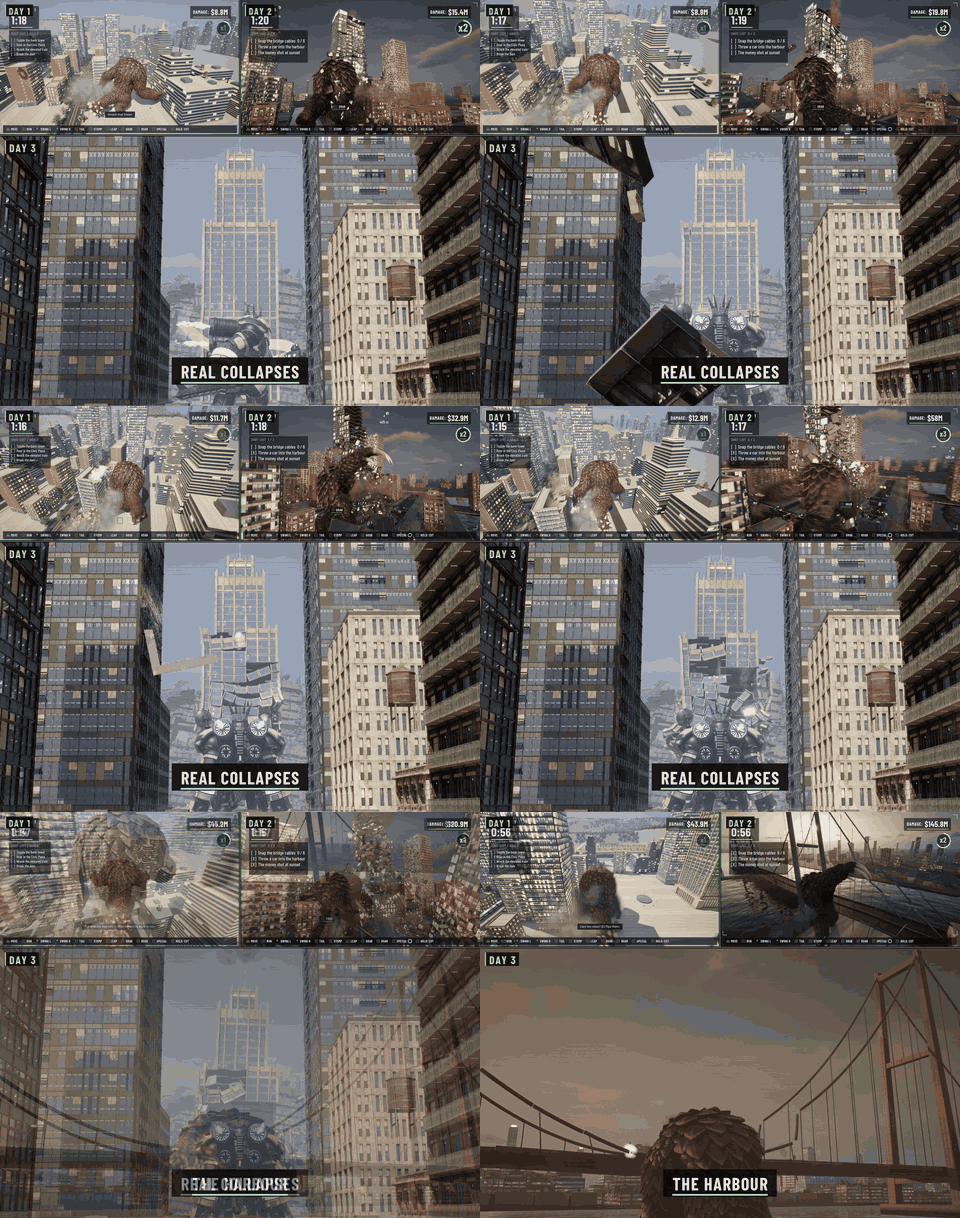
- A 74-second trailer and a Day 1 / Day 2 / Day 3 comparison clip (outside the game).
Sources
- each bullet from the section above that tells it
Next in the game
Tonight: final-check, one combined play test of the whole build on the test copy after the last fix (108); then the evening package, with the size gate at 2.2 GiB (134). The itch push of the evening build waits for Mifsopo's OK on that build (he gave it at 22:3x, decision 143, and build 2201 went up on the itch page). He then records the jam-form gameplay video himself with OBS from that build, with the game's real sound, and agents cut it to 30 to 60 seconds with titles (111). After the package a smoke and dust pass stops smoke reading as default white discs (128). The final post is due by 13:00 ET Sunday.
Sources
- design/qa/decisions_1805.md 143, 148 ("itch took 2.30"); filled in for the site on 2026-11-15 by devlog_capture site-v2 (decision 158)
- decisions 108, 111, 128, 134, 135; journal/TEST_EDITOR_OWNER.md
How it is made: Mifsopo and the agents
Smash Cut is made by one person, Mifsopo, and a team of Claude Code AI agents. Mifsopo directs: he chose the game, plays every build, writes the notes and makes every design call. The agents build, each in its own lane: gameplay code (C++), the integrator (the one Unreal editor: imports, builds, packages), characters and animation, environment and props (both in Blender), level and lighting, UI, effects, audio and music, and this dev log. Each piece of work is a stage: one agent run with a brief and a goal, started by our stage runner, driving Unreal through MifBridge and Blender through MifBlender (Mifsopo's own tools), every call logged. At the end of a stage the agent captures the progress cameras, renders what it built (clay, wireframe, final), and writes a journal entry: what it did, what failed, and how it fixed that, with the before and after frames. The attached book and the numbers below are built by a script from those logs, not written from memory. Nothing is posted, uploaded or published by an agent: Mifsopo does every upload and every post himself.
Day 3 in numbers (computed from the logs at 20:19-20:22 ET, cut 20:22; the day was not quite over, so these are a little low):
- 132 stages (Nov 14, 00:00 to 20:22 ET), 14,022 tool calls from the stage logs, 66 hours 7 minutes of agent work added up across stages (stages overlap, so this is not elapsed time).
Sources
- a local folder "Total" row, scripts/devlog_build.py --day 3 --no-motion, built 20:22 ET (the run was stopped after costs.md was written because free RAM fell under 12 GB)
- Token cost at Anthropic's published API prices: $1,200.32, an API-rate equivalent, not money spent: Mifsopo works on a flat plan at $200 a month, about $6.67 a day. It is a lower bound: 9 stages still running or without a final token count are missing, and this lane's own stage is counted only so far.
Sources
- costs.md "$1200.32 (partial)"; plan price from DEVLOG_PLAN 8
- By lane (API-rate): gameplay_code $242.14 over 19 stages, characters_animation $224.45 over 17, environment_props $205.90 over 11, integrator $130.25 over 16, vfx $119.69 over 19, devlog_capture $91.91 over 21, level_lighting $89.30 over 9, ui $88.07 over 18, audio_music $8.59 over 2. Models: claude-opus-5-5 $1,125.31, claude-fable-5-2 $66.24 (the planning and review stages), claude-sonnet-5-5 $8.76.
Sources
- costs.csv stage rows, summed per lane and model
- Calls counted from logs/calls.jsonl and bl_calls.jsonl for Nov 14 up to 20:19 ET: 167,121 bridge calls (Unreal) and 906,451 Blender ops, and 221 FAIL lines (220 with a FIX line directly under them) in the lane journals' Nov 14 entries, each written down with what fixed it. These are far above the 14,022 tool calls counted from the stage logs: the stage logs count an agent's own tool uses, and the call logs also hold every request the capture, render and import scripts make. Both counts are real; they count different things.
Sources
- byte count of '"ts": "2026-11-14T' lines in the two logs (a local folder, run 20:19); FAIL/FIX lines counted in journal/*.md entries dated 2026-11-14 (prep, overnight and OWNER files excluded), run 20:24; the Blender log's last line is from 17:04
- Renders: 629 routing decisions on Nov 14: 293 local, 335 on the second render seat, one local without the lock; of the remote jobs, 325 finished and 8 were abandoned back to local.
Sources
- logs/render_routes.jsonl, rows with time on 2026-11-14, counted 20:24
- Why the day cost what it did, in one line: every lane ran in parallel on Opus 5.5 while the planning model took the review and planning stages, and the biggest bills are the code lane's specials, climbing, quality and perf work and the environment lane's kits and two texture revamps.
Declarations
- Made during the jam by AI agents (Claude Code), directed by Mifsopo: the code, models, textures, animations, levels, UI, effects, and the sound design built from the sourced sounds. Every model is built in Blender with our own scripts. No generated mesh, image or texture is in the game.
- Concept references: an AI concept sheet per monster was used as a reference only. It is never imported into the game, traced or shown in it.
- Generative tools: the B-movie one-sheets' taglines, billing lines and invented cast and crew were written by an AI agent (the titles were drafted by an AI agent and picked by Mifsopo); the poster art is a render of our own models, painting-graded, over our own city. Pangoliath's roar and the low layer of the giant footsteps are takes from Mifsopo's Audio Hero sound-effect generator. The first music sketch was written by an AI agent in REAPER. New today: the trailer's voiceover is an AI voice made with ElevenLabs (voice "David - Movie Trailer Narrator", model Eleven v4, English) by Mifsopo on Nov 14 during the jam, from a 12-line script written by an agent (decision 100); it is in the trailer only, and the game itself has no voice. The critics' lines and the poster pull quotes in the game are text written by us from templates and the player's own cut, not spoken. The 47 destruction sounds and 17 water sounds are built in REAPER from library audio only (no generator, no synthesis).
- Sourced assets (declared, not scored): Ultra Dynamic Sky (Fab); sound and music from Mifsopo's Audio Hero packs; 71 sound effects from We Love Indies (Dynamedion); input glyphs from an Input Icon Pack (no platform logos); fonts Barlow Condensed and IBM Plex Mono (SIL OFL 1.1) and Roboto (engine font).
- Music: the first music sketch (00:18 on Day 1) was written by an AI agent in REAPER. Other music is from Mifsopo's own library, and the cold open uses the orchestral studio ident from it.
- No MetaHumans. No logos except the Unreal Engine logo (the cold open and the splash show it with Epic's notice).

 Clay
 Wire
 Final


